
- Al-Yarmouk St., Madaba - Next to Mosaic City Hotel
- Daily : 8.00 am to 10.00 pm
Where Passion Meets Craft
Cortado Coffee House was built on one belief — that great coffee deserves great care. With 18 years of specialty coffee experience behind every cup, we bring expertise, warmth, and an uncompromising commitment to quality to every visit.
Contact Info
- Al-Yarmouk St., Madaba
- +962779210093
- info@cortado-coffee.com
- 28 June, 2026
- By: Mohammad Ali
Discover the full documented difference between Arabic coffee (qahwa) and Italian espresso — history, preparation, culture, caffeine, and flavour. A complete guide from Cortado Coffee House in Madaba, Jordan.
☕ Coffee Culture · History · Madaba, Jordan
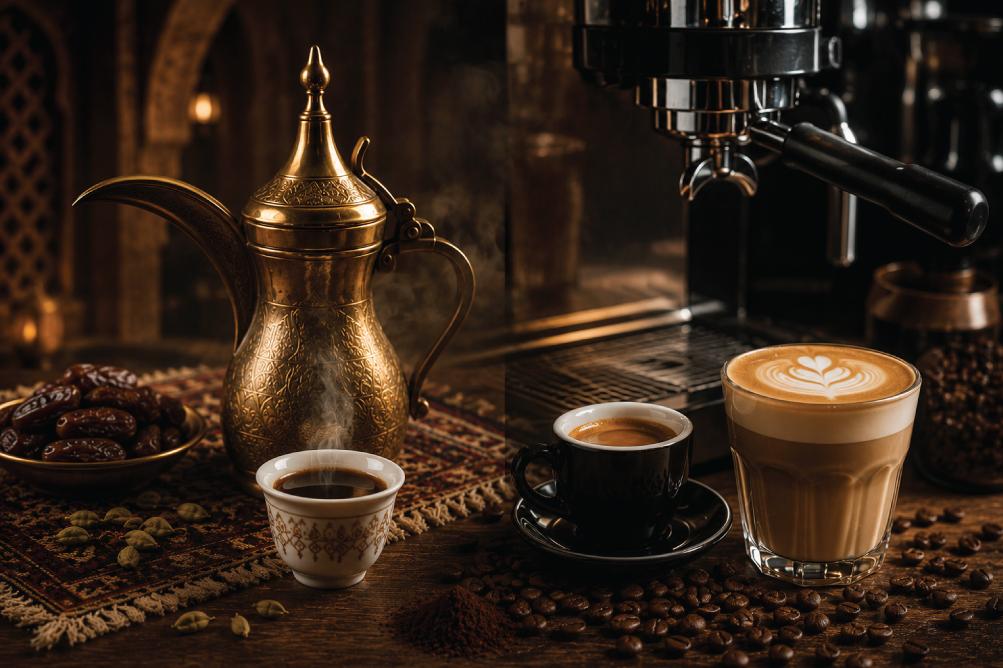
Arabic Coffee vs. Italian Coffee
Two Civilisations, Two Philosophies, One Passion
From Yemen's 15th-century Sufi monasteries to Turin's 1884 espresso patent — the full, documented story of how the world's two greatest coffee traditions were born, how they differ, and where they meet at Cortado Coffee House in Madaba.
📋 In This Article
- Why These Two Traditions Matter
- The Origin of Arabic Coffee — Yemen & Beyond
- Arabic Coffee Culture, Ritual & UNESCO Heritage
- How Arabic Coffee Is Made
- The Origin of Italian Coffee & Espresso
- Italian Coffee Culture & Bar Etiquette
- How Italian Espresso Is Made
- Side-by-Side: Full Comparison Table
- Coffee in Jordan — Where Both Worlds Meet
- Cortado Coffee House: Bridging Both Traditions
- Download the Cortado App
- Frequently Asked Questions
Introduction
Why These Two Coffee Traditions Matter More Than You Think
The word "coffee" entered the English language in 1582 via the Dutch koffie, borrowed from the Ottoman Turkish kahve, which in turn came from the Arabic qahwa (قهوة). The entire planet's vocabulary for this drink traces back to the Arab world. And yet the ritual most associated with coffee in the modern era — the sharp, pressurised shot pulled in seconds under 9 bars of force — was invented in Turin in 1884. Two civilisations. Two entirely different philosophies about what coffee should be, how it should be made, and above all, what it means to share it.
This is not a competition. Both traditions are magnificent, both are ancient by the standards of modern food culture, and both have shaped the world's relationship with coffee in ways that cannot be separated or ranked. But understanding the differences between Arabic coffee and Italian coffee — the origins, the ingredients, the preparation methods, the cultural meanings — is one of the most illuminating journeys a coffee lover can take.
At Cortado Coffee House in Madaba, Jordan, we are uniquely positioned at the intersection of these two traditions. We are a specialty coffee café built on Italian espresso technique and third-wave coffee science, operating in a country where Arabic coffee (qahwa) has been declared an Intangible Cultural Heritage of Humanity by UNESCO. Every day, guests come to us carrying both traditions — and we honour both.
This article is the complete, documented guide to Arabic coffee vs. Italian coffee: where they came from, how they are made, how they differ, and what a café in the heart of Jordan's mosaic city does with both.
15th C.
Century Arabic coffee was first documented in Yemen's Sufi monasteries
1884
Year Angelo Moriondo of Turin patented the world's first espresso machine
2015
Year UNESCO inscribed Arabic coffee as Intangible Cultural Heritage of Humanity
Section One
The Origin of Arabic Coffee — From Yemen to the World
The earliest credible evidence of coffee drinking appears in the middle of the 15th century in Yemen, where Sufi monks used a brew made from roasted coffee beans to maintain alertness during their long nighttime devotions. The port city of Mokha (Al-Mukha) in Yemen was the first great commercial centre of the coffee trade, and the drink spread outward from there along Islamic pilgrimage and trade routes with extraordinary speed.
From Yemen, coffee travelled north to Mecca and Medina, then to Egypt and the Levant (including what is today Jordan, Syria, and Lebanon), and by the mid-16th century it had reached Istanbul and the Ottoman Empire. It was the Ottoman trade networks that eventually carried coffee to Europe — reaching Venice in the late 16th century, Paris and London in the mid-17th century, and Vienna in 1683 following the Battle of Vienna, when Viennese merchants obtained coffee from the supplies of the retreating Ottoman army. The English word "coffee" itself, the Italian "caffè", the French "café" — all ultimately derive from the Arabic qahwa.
The first coffeehouses in history appeared in Mecca in the 15th century. Known as qahveh khaneh, these establishments served as social hubs where people gathered to discuss politics, listen to music, play chess, and exchange news. They spread rapidly across the Ottoman Empire, reaching Cairo, Damascus, and Istanbul by the 16th century — functioning, in many ways, as the internet of their era: the fastest, most reliable way to share information across a vast geography.
"Arabic coffee originated in Greater Yemen, beginning in the port city of Mokha and eventually travelling to Mecca, Egypt, the Levant, and then, in the mid-16th century, to Turkey and from there to Europe — where coffee eventually became popular as well." — Wikipedia: Arabic Coffee (citing academic sources on coffee history)
The word qahwa itself is believed to derive from a Semitic root meaning "dark colour" — a natural description of the brew. Some linguistic analyses also connect it to an earlier meaning of "wine" or "that which suppresses appetite." Whatever the etymology, by the time coffee reached Europe, its Arabic name had already become embedded in the languages of a dozen cultures, from Italian to Dutch to English.
Coffee in Jordan — An Ancient and Living Tradition
In Jordan specifically, qahwa sādah — black, cardamom-flavoured "welcome coffee" — has been and remains a central expression of hospitality and social identity. According to UNESCO's documentation of this tradition, Arabic coffee is served at weddings and tribal gatherings including reconciliation councils (majalis) in Jordan, and is a fixture in the offices of government officials, ministers, and community leaders. It is present in virtually every Jordanian home, whether in Jordan or in the diaspora. The tradition of offering coffee to a guest before any conversation begins is not merely polite — it is a cultural signal of respect and sincerity that carries profound social weight.
Section Two
Arabic Coffee Culture, Ritual & UNESCO Heritage
In 2015, UNESCO inscribed Arabic coffee — "a symbol of generosity" — on its Representative List of the Intangible Cultural Heritage of Humanity. Jordan was among the submitting states, alongside Saudi Arabia, the UAE, Oman, and Qatar. The designation recognised that the importance of qahwa lies not just in the drink itself, but in the entire cultural system surrounding it: the knowledge, the rituals, the social etiquette, and its central role in promoting hospitality, reconciliation, and social cohesion.
UNESCO Intangible Cultural Heritage — Since 2015
Arabic coffee was inscribed on UNESCO's Representative List of the Intangible Cultural Heritage of Humanity in 2015, recognising it as a living cultural tradition that embodies generosity, hospitality, and social identity across the Arab world — including Jordan. The designation covers not just the drink, but the entire ritual, knowledge system, and social etiquette surrounding its preparation and serving.
The ritual of Arabic coffee is highly specific and carries layers of meaning. The host, or the eldest son, moves clockwise among guests, pouring coffee according to age and social status — older guests and those of higher standing are always served first. The cup (a small, handleless finjān) is filled only a quarter to half full; refilling it is an act of ongoing hospitality. Custom holds that it is polite to accept at least one cup, and drinking three is considered a gracious acknowledgment of the host's generosity. When a guest has had enough, they gently shake the cup side to side — a wordless signal that means "thank you, I am satisfied."
The preparation itself has traditionally been performed in front of guests — a deliberate act of transparency and care. The host begins by selecting beans, roasting them in a shallow pan (mihmas) over open fire, then crushing them in a large wooden or stone mortar (mihbaj). The rhythmic sound of the pestle striking the mortar was historically used as a signal to neighbours: coffee was being made, and guests were welcome. This is hospitality made audible.
The Dallah
The traditional Arabic coffee pot, made of brass or copper, with a long spout and a distinctive shape. In the Gulf, its design has become a national symbol — appearing on coins and official emblems.
The Finjān
Small, handleless cups in which Arabic coffee is served. Filled only a quarter to half full — partly for temperature, partly as an invitation to accept more.
Cardamom
The essential spice of Arabic coffee. Freshly crushed cardamom pods are added during brewing, imparting a floral, slightly citrusy warmth. In Bedouin tradition, generous use of cardamom signalled the host's wealth and generosity.
Saffron & Cloves
Optional but common additions, especially in Gulf countries. Saffron gives the coffee a golden colour and a subtle floral complexity. Cloves add depth and warmth. Often reserved for special occasions due to cost.
Regional Variations Across the Arab World
Arabic coffee is not monolithic. Each region — even each family — has developed its own version of the tradition. In Saudi Arabia, particularly the Najd and Hejaz regions, a very light roast gives the coffee a golden or blonde colour, almost like green tea in appearance. In Gulf states, qahwa khaleeji uses heavy saffron and cardamom with very light roasts, producing a bright yellow brew. In Yemen, spice blends called hawaij are added. In the Levant — including Jordan — the coffee is closer to Turkish in style but typically spiced with cardamom and prepared in a long-handled pot called a rakwa. In Jordan, qahwa murra ("bitter coffee") is commonly served among Bedouin communities on special occasions, made with darker roast beans and no sugar.
Section Three
How Arabic Coffee Is Made — The Process in Detail
The preparation of Arabic coffee varies by region, but the traditional method follows a common sequence that has been passed down through generations primarily through observation and family practice rather than written recipe.
Step 1 — Bean Selection
Choosing the Green Beans
Arabic coffee uses Coffea arabica beans — the same species used in specialty espresso, but treated very differently. The beans are selected raw (green) and assessed for quality before roasting. Traditional knowledge about bean selection is passed from elders to younger family members at the market, a practice UNESCO specifically noted in its heritage documentation.
Step 2 — Roasting
Light-to-Medium Roasting in a Mihmas
Green beans are roasted in a flat, long-handled iron or bronze pan called a mihmas over open flame, stirred constantly for even heat distribution. Arabic coffee uses a much lighter roast than Italian espresso — typically reaching only what Western roasters would call a "light" to "cinnamon" roast, producing beans that are golden to light brown rather than dark. This preserves more of the bean's natural aromatics and results in a flavour profile that is floral, mildly bitter, and often tea-like in body.
Step 3 — Grinding
Crushing in the Mihbaj
Once cooled, the beans are crushed in a mihbaj — a large wooden or stone mortar and pestle. The grinding is typically coarser than espresso grind, producing a texture closer to sea salt than powder. The rhythmic sound of the mihbaj was historically the community's signal that coffee was being prepared and company was welcome.
Step 4 — Brewing
Simmering in the Dallah with Spices
Ground coffee is combined with water and spices — primarily crushed cardamom pods — in a dallah or briki and brought to a simmer over low heat. Unlike espresso, this is a slow, boiling method with no pressure involved. The coffee is simmered for 10–15 minutes, allowing the cardamom and any other spices (saffron, cloves, rosewater) to fully infuse. The mixture is then strained and transferred to a serving dallah. Coffee grounds settle at the bottom naturally.
Step 5 — Serving
The Ritual of the Finjān
Coffee is poured into small, handleless finjān cups — filled only a quarter to half — and served by the host or eldest son, moving clockwise among guests in order of seniority. Dates, dried fruit, or nuts are offered alongside to balance the coffee's bitterness with natural sweetness. No sugar is added to the coffee itself in most traditional preparations; the sweetness comes from the accompaniment.
The caffeine content of Arabic coffee is notably lower than Italian espresso — ranging from approximately 4 to 40 mg per 30–60 ml serving, compared to 60–75 mg in a standard double espresso shot. This is a result of the light roast (lighter roasts retain more caffeine, but the lower extraction efficiency of the boiling method and the smaller serving size balance this out), the coarser grind, and the slow, low-pressure brewing method. Arabic coffee is not designed to be a caffeine delivery system. It is designed to be a reason to sit together.
Section Four
The Origin of Italian Coffee & the Birth of Espresso
Coffee arrived in Italy through Venice in the late 16th century, facilitated by the city's thriving trade networks with North Africa and the Middle East. The Arabic word qahwa became Italian caffè through Ottoman Turkish — another linguistic trace of coffee's Arab origins. By the 17th century, coffeehouses had spread across Italian cities, and coffee had become deeply embedded in Italian daily life.
But the transformation of coffee from a slow-brewed, simmered beverage into the concentrated, pressurised, seconds-fast shot we know as espresso is entirely an Italian invention — and its story begins with the Industrial Revolution and a specific problem: speed.
1884 — Turin, Italy
Angelo Moriondo Patents the First Espresso Machine
In the late 19th century, coffee preparation took up to five minutes per cup — far too slow for the busy cafés of industrial Italy. Angelo Moriondo, a Turin entrepreneur born in 1851, designed a machine that used steam pressure to force hot water through coffee grounds in a fraction of the time. He filed patent No. 33/256 — titled "New steam machinery for the economic and instantaneous confection of coffee beverage" — and presented it at the Turin General Exhibition of 1884, winning a bronze medal. He never commercialised the invention widely, but the patent laid the conceptual foundation for everything that followed.
1901 — Milan, Italy
Luigi Bezzera Invents the Single-Shot Espresso
Milanese manufacturer Luigi Bezzera improved on Moriondo's concept by creating a machine that could brew coffee directly into the cup, quickly and on demand. He is credited with inventing the single-shot espresso as a commercially viable product. Desiderio Pavoni subsequently acquired the patent and commercialised it, and the two men presented the refined machine at the 1906 Milan International Exposition — introducing the term "caffè espresso" above their stall for the first time.
1933 — Turin, Italy
Alfonso Bialetti Invents the Moka Pot
Italian engineer Luigi Di Ponti invented the first moka pot in 1933 and sold the patent to Alfonso Bialetti, whose son Renato started industrial production in 1946, selling millions of units globally. The moka pot brought espresso-style coffee into the home, democratising the intensity of café espresso for domestic use and becoming an icon of Italian identity worldwide.
1945 — Milan, Italy
Achille Gaggia Invents the Modern Espresso Machine
Achille Gaggia introduced the lever-operated espresso machine in 1945 (patented 1938), creating the first machine capable of producing 9 bars of pressure — the standard that defines modern espresso extraction. This machine produced the characteristic dense crema on the surface of an espresso shot for the first time, and established the extraction parameters (9 bars, 93°C, 25–30 seconds) that remain the global standard for specialty espresso today.
"The Ottomans' dominant position in the trade in coffee is thought to have influenced several other European languages as well, inspiring 'caffè' in Italian and 'café' in French — tracing Italian coffee culture's vocabulary directly back to Arabic roots." — Wikipedia: History of Coffee
Section Five
Italian Coffee Culture — Speed, Precision & the Bar Ritual
If Arabic coffee culture is built around slowness — the deliberate, ceremonial, hour-long act of preparing and sharing coffee as an expression of hospitality — then Italian coffee culture is built around speed and precision. The espresso bar is a place of controlled urgency: a well-run bar in Naples or Rome can serve dozens of customers in an hour, each receiving a perfectly pulled 25-second shot of concentrated coffee, consumed standing at the counter in two or three sips.
This is not a lesser form of coffee culture. It is a different philosophy entirely. The Italian approach values the distillation of coffee to its absolute essence: a small, dense, intensely flavoured shot that delivers maximum flavour information in minimum time and volume. The crema — the layer of emulsified oils and CO₂ bubbles that forms on the surface of a well-pulled espresso — is both an aesthetic marker and a quality indicator. A thick, uniform, reddish-brown crema signals that the extraction was correct: the grind was right, the pressure was right, the temperature was right, and the bean was fresh.
Regional Variations Within Italian Coffee Culture
Italy itself is not uniform in its coffee culture. Research published in the ICC2024 proceedings documents significant regional variation: northern Italy, influenced by Austria's café culture and earlier access to Arabica beans through Alpine trade routes, tends toward lighter, more delicate blends with a preference for Arabica beans. Southern Italy — particularly Naples, which is the spiritual home of Italian espresso — favours darker roasts, higher proportions of Robusta beans, and an intensity of flavour and body that reflects a different aesthetic entirely. Neapolitan espresso is characterised by its profound darkness, rich aroma, and robust bitterness — a style that has influenced Italian-American espresso culture in cities like New York and Chicago.
The Unwritten Rules of the Italian Coffee Bar
- Espresso is consumed standing at the bar — sitting down is reserved for tourist prices. The traditional Italian morning includes a quick espresso or cappuccino consumed in approximately 90 seconds at the counter before work.
- Cappuccino is a morning drink only — ordering a cappuccino after midday or after a meal is a cultural faux pas in traditional Italian culture. The reasoning is that milk disrupts digestion after a meal. After noon, you drink espresso, ristretto, or macchiato.
- Espresso is inexpensive — in many Italian bars, an espresso costs €1.00 or less at the counter. Coffee is considered a daily democratic right, not a premium experience. This culture of affordable quality has deep historical roots.
- No flavoured syrups in traditional bars — vanilla latte, hazelnut cappuccino, caramel macchiato are American inventions. In a traditional Italian bar, you drink what the machine and the barista produce — unadulterated.
Section Six
How Italian Espresso Is Made — The Science of Extraction
The making of a proper Italian espresso is a process governed by physics, chemistry, and years of trained intuition. Unlike Arabic coffee, which tolerates and even celebrates variability and the hand of individual tradition, espresso demands precise, repeatable conditions — and the slightest deviation from the parameters produces a noticeably different result.
The Extraction Parameters
What must be precisely controlled
- Temperature: 93–94°C water at the group head
- Pressure: 9 bars — the standard established by Gaggia in 1945
- Extraction time: 25–30 seconds for a double shot
- Brew ratio: 1:2 (dose to yield) — 18g coffee → 36g espresso
- Grind size: Very fine — dialled daily based on humidity, pressure, and the specific bean lot
The Bean & Roast
What goes into the machine
- Species: Arabica, Robusta, or blends — unlike Arabic coffee, Italian espresso commonly uses Robusta (especially in southern Italy) for body and crema
- Roast level: Medium to dark — much darker than Arabic coffee's light roast
- Freshness window: 7–21 days post-roast for peak flavour
- Grind timing: Ground immediately before extraction — pre-ground coffee degrades rapidly
The result of a correctly executed espresso extraction is a small (25–40ml), intensely concentrated shot with a layer of crema on top. The crema contains emulsified coffee oils, dissolved CO₂, and thousands of aromatic compounds that contribute to the espresso's complex flavour profile — which can include notes of chocolate, caramel, fruit, nuts, and flowers depending on the bean origin and roast. Caffeine content in a standard double espresso is approximately 60–75 mg — significantly higher than Arabic coffee, delivered in a fraction of the volume.
Section Seven
Arabic Coffee vs. Italian Coffee — The Complete Comparison
Here is the full, documented side-by-side comparison of these two great coffee traditions across every meaningful dimension.
| Dimension | ☕ Arabic Coffee (Qahwa) | 🇮🇹 Italian Coffee (Espresso) |
|---|---|---|
| Origin | Yemen, 15th century — Sufi monasteries in Mokha | Italy, 1884 — Angelo Moriondo's patent in Turin |
| Bean Species | 100% Coffea arabica — often lightly roasted green beans | Arabica, Robusta, or blends (especially in southern Italy) |
| Roast Level | Very light to light — golden/blonde colour retained | Medium to dark — deep brown with oily surface |
| Brewing Method | Slow boiling / simmering in a dallah — no pressure | High-pressure extraction — 9 bars of force in 25–30 seconds |
| Spices & Additions | Cardamom (essential), saffron, cloves, rosewater | None in traditional espresso — pure coffee only |
| Sugar | Usually none — sweetness comes from dates served alongside | Optional — many Italians add sugar at the bar |
| Milk | Almost never — served black as a cultural standard | Forms the base of cappuccino, latte, cortado, flat white |
| Serving Vessel | Small handleless finjān cups, quarter to half-filled | Demitasse ceramic or small glass, fully filled (25–40ml) |
| Serving Ritual | Host pours clockwise by seniority; 3 cups is gracious; shake to decline | Ordered and collected at the bar — often consumed standing |
| Caffeine (per serving) | 4–40 mg per 30–60 ml | 60–75 mg per 25–40 ml double shot |
| Flavour Profile | Floral, aromatic, mildly bitter, tea-like body, cardamom-forward | Intense, concentrated, complex — chocolate, caramel, fruit notes |
| Time to Prepare | 15–30+ minutes (including roasting and grinding) | 25–30 seconds from grind to cup |
| Cultural Meaning | Hospitality, generosity, respect — a social ceremony | Efficiency, pleasure, daily rhythm — a personal ritual |
| UNESCO Status | Inscribed as Intangible Cultural Heritage of Humanity — 2015 | Traditional Italian espresso culture inscribed by UNESCO — 2022 |
| Global Influence | Gave the world the word "coffee" and the concept of the coffeehouse | Created the espresso machine, the café bar, and the modern coffee menu |
What this table cannot fully capture is the most important dimension of difference: the relationship each tradition has with time. Arabic coffee asks the world to slow down — to sit, to share, to honour the guest with the gift of unhurried attention. Italian espresso asks the world to concentrate — to extract maximum flavour and energy in minimum time. Both are responses to genuine human needs. Both, at their best, represent coffee culture operating at its highest expression.
Section Eight
Coffee in Jordan — Where Both Worlds Meet
Jordan occupies a unique position in the global coffee story. It sits geographically and culturally at the crossroads of the Arab world — a country whose coffee heritage stretches back through the same Levantine trade routes that carried qahwa from Yemen to Europe in the 16th century, and whose Bedouin communities have practiced the ritual of Arabic coffee for generations as one of their most defining cultural acts.
At the same time, Jordan is a modern, globally connected society where Italian espresso culture has taken firm root. Coffee shops and cafés serving lattes, cappuccinos, and cortados are fixtures of Amman's urban landscape and increasingly common in cities like Madaba, Aqaba, and Zarqa. The Jordanian coffee drinker navigates both traditions with ease — drinking qahwa at home and at formal occasions, ordering an espresso-based drink at a café, and understanding both as genuine expressions of coffee's value.
Madaba specifically is a city that embodies this intersection. As the home of the world's oldest geographic mosaic — a 6th-century Byzantine masterwork in the Church of Saint George that maps the Holy Land with extraordinary precision — Madaba is a city built on the idea that different traditions and influences can be combined into something more beautiful than any single source. The mosaic makers of Madaba did not choose between the Byzantine, the Arab, and the Mediterranean influences they inherited. They wove them together. Coffee culture in modern Madaba does the same.
Section Nine
Cortado Coffee House — Bridging Both Traditions in Madaba
When Cortado Coffee House opened in Madaba in 2023, it brought a specific vision: specialty coffee at the highest standard, in a city that has always understood what it means to honour a craft. The café is named after the cortado — a Spanish espresso drink that sits precisely at the intersection of espresso's intensity and the milk's softening influence — and it operates on Italian espresso principles of precision and extraction science. But it operates in Jordan, in a city where Arabic coffee has been the language of welcome for centuries.
This is not a contradiction. It is, we believe, exactly the right conversation to be having.
What We Share with Arabic Coffee
The values that connect us
- The belief that offering coffee is an act of hospitality and respect
- The use of 100% Arabica beans — the same species at the heart of qahwa
- The insistence on freshness as a non-negotiable standard
- The understanding that coffee is a social act, not merely a transaction
- Deep roots in Jordan's culture of welcome and generosity
What We Take from Italian Coffee
The craft and technique
- 9-bar pressure extraction for maximum flavour concentration
- Daily grinder calibration — adjusting for humidity, temperature, and lot
- 93–94°C water temperature for optimal extraction
- The cortado, flat white, latte, and cappuccino — espresso-milk drinks built on precision
- 18 years of specialty coffee barista expertise behind every cup
At Cortado Coffee House in Madaba, every guest who sits down is — whether they know it or not — benefiting from both traditions simultaneously. The care and hospitality is Arabic in spirit. The espresso in the cup is Italian in technique. The beans are Arabica in species — the same family of plant that Yemeni farmers cultivated for Sufi monks six centuries ago. The result is a cup that carries history in every sip.
"The cortado tolerates no shortcuts. Which is exactly why it is the drink we chose to put our name on. If we can make a perfect cortado every time, we can make any coffee drink perfectly. And if we can do that in Madaba — a city built on the value of craft — then we are exactly where we belong." — Cortado Coffee House, Madaba · Est. 2023
Our Menu: Where Both Worlds Are Welcome
- The Cortado — Our signature and namesake. Double espresso with equal-part steamed milk in a clear 4 oz glass. Italian in method, Jordanian in warmth.
- Latte, Cappuccino, Flat White — The full family of Italian espresso-milk drinks, each made to specialty standard with daily-dialled espresso.
- Filter Coffee & Single Origin — Rotating offerings from Ethiopia, Yemen, Colombia, and beyond — exploring the full geography of Arabica, including origins with historical ties to Arabic coffee tradition.
- Cold Brew & Iced Drinks — Slow-steeped or espresso-based cold coffees for Madaba's warm afternoons.
📱 Free on iOS & Android
Order Ahead with the Cortado App
Browse the full menu, place your order before you arrive, earn loyalty points with every purchase, and stay connected to everything happening at Cortado Coffee House in Madaba. Available free on iOS and Android.
Frequently Asked Questions
Arabic Coffee vs. Italian Coffee — Your Questions Answered
Which is older — Arabic coffee or Italian espresso?
Arabic coffee (qahwa) is far older. The earliest documented evidence of coffee drinking dates to the 15th century in Yemen, with coffeehouses appearing in Mecca shortly after. Italian espresso was invented in 1884 by Angelo Moriondo in Turin — approximately 400 years later. The word "caffè" in Italian itself derives from the Arabic "qahwa" via Ottoman Turkish.
Does Arabic coffee contain more or less caffeine than espresso?
Significantly less. Arabic coffee contains approximately 4–40 mg of caffeine per 30–60 ml serving, while a standard double espresso contains 60–75 mg in 25–40 ml. The lighter roast, coarser grind, slow boiling method, and smaller serving all contribute to the lower caffeine yield in Arabic coffee.
Why is Arabic coffee recognised by UNESCO?
In 2015, UNESCO inscribed "Arabic coffee, a symbol of generosity" on its Representative List of the Intangible Cultural Heritage of Humanity. Jordan was among the submitting states. UNESCO recognised not just the drink but the entire cultural system — the preparation rituals, the social etiquette, the hospitality values, and the intergenerational transmission of knowledge — as a living heritage worth protecting.
What is the main flavour difference between Arabic and Italian coffee?
Arabic coffee is floral, aromatic, tea-like in body, and cardamom-forward — the light roast preserves the bean's natural aromatics and the spices add complexity. Italian espresso is intense, concentrated, and complex — with notes of chocolate, caramel, and fruit from the medium-to-dark roast and high-pressure extraction. Both use Arabica beans as a base, but the processing could not produce more different results.
Can I experience both traditions at Cortado Coffee House in Madaba?
Cortado Coffee House is built on Italian specialty espresso technique, offering the full range of espresso-based drinks — cortado, latte, flat white, cappuccino, and more. We also offer single-origin filter coffees that connect to the same Arabica heritage at the heart of Arabic coffee tradition. We operate in Jordan, where Arabic coffee culture has shaped our understanding of hospitality — and that spirit is present in every interaction at our café.
Where is Cortado Coffee House and when is it open?
Cortado Coffee House is located on Al-Yarmouk Street, Madaba — directly next to Mosaic City Hotel. We are open daily from 8:00 AM to 10:00 PM. Reach us on WhatsApp at +962 77 921 0093 or visit cortado-coffee.com.
Two Great Traditions. One Great Café. Madaba.
Whether you came here to understand the history of coffee, or simply to find the best café in Madaba — the answer to both questions is the same. Come in. Sit down. Let us make you something worth the journey.
Leave a comment
Your email address will not be published. Required fields are marked *
Where Passion Meets Craft
Cortado Coffee House was built on one belief — that great coffee deserves great care. With 18 years of specialty coffee experience behind every cup, we bring expertise, warmth, and an uncompromising commitment to quality to every visit.
Contact Info
- Al-Yarmouk St., Madaba
- +962779210093
- info@cortado-coffee.com