
- Al-Yarmouk St., Madaba - Next to Mosaic City Hotel
- Daily : 8.00 am to 10.00 pm
Where Passion Meets Craft
Cortado Coffee House was built on one belief — that great coffee deserves great care. With 18 years of specialty coffee experience behind every cup, we bring expertise, warmth, and an uncompromising commitment to quality to every visit.
Contact Info
- Al-Yarmouk St., Madaba
- +962779210093
- info@cortado-coffee.com
- 29 June, 2026
- By: Mohammad Ali
Colombian coffee vs Ethiopian coffee compared for espresso: flavour profiles, acidity, body, processing, and roast levels. Research-backed guide from Cortado Coffee House, Madaba.
Coffee Origins · Espresso · Specialty Coffee
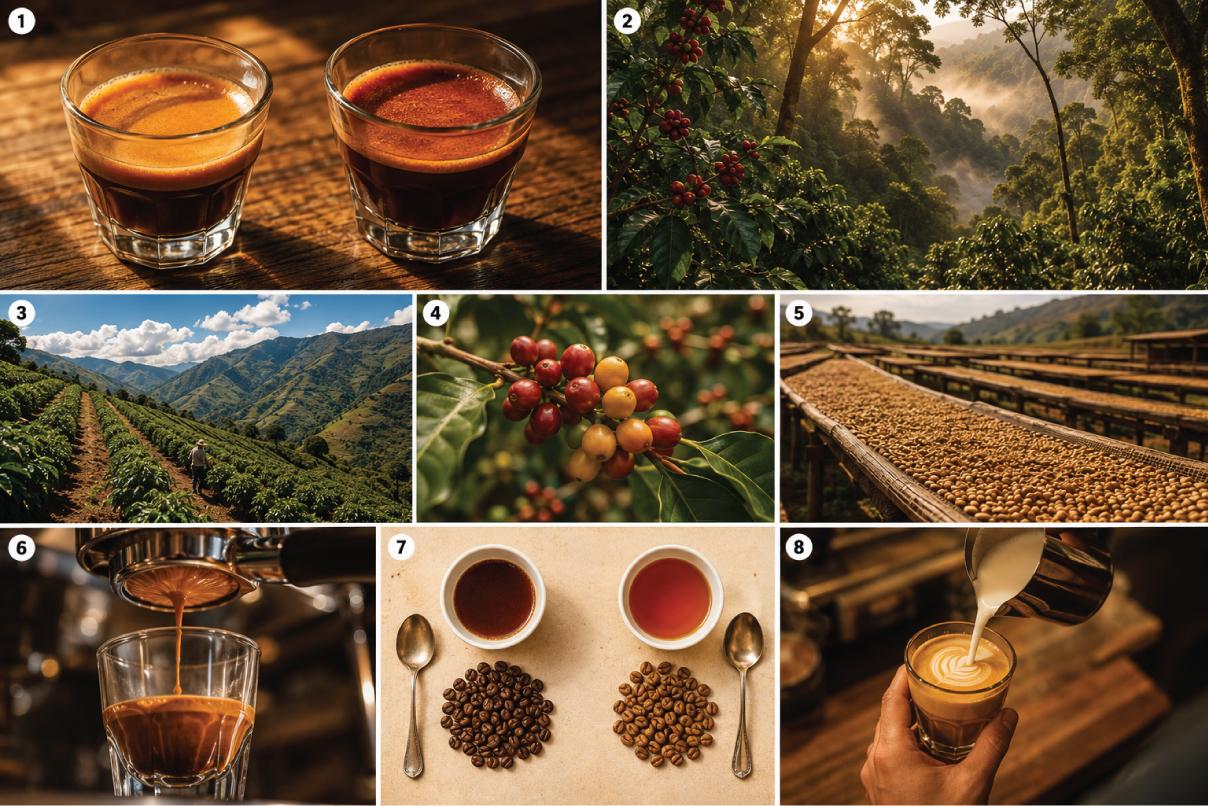
Colombian Coffee vs. Ethiopian Coffee
Which Origin Produces the Better Espresso?
Two of the world's greatest coffee origins — one the birthplace of Arabica, the other its most famous ambassador — compared across every dimension that matters for espresso: flavour, body, acidity, processing, and what each brings to the cup.
In This Article
- Why This Comparison Matters
- Ethiopia: The Birthplace of All Coffee
- Colombia: The World's Espresso Workhorse
- Growing Regions Compared
- Varieties and Cultivars
- Processing Methods and Their Impact
- Flavour Profiles: Side by Side
- The Full Comparison Table
- Which Origin Makes Better Espresso?
- Roast Levels and Espresso Extraction
- Both Origins at Cortado Coffee House
- Frequently Asked Questions
If you have spent any time exploring specialty coffee, two origins will have appeared on your radar more than any others: Colombia and Ethiopia. They dominate café menus, competition stages, and roaster offerings worldwide — and for very good reasons. Colombia is the world's third-largest coffee producer and the origin most associated with balanced, reliable, crowd-pleasing espresso. Ethiopia is the biological birthplace of all Arabica coffee, home to more genetic diversity than every other producing country combined, and the source of some of the most distinctive and memorable espresso shots a person can experience.
But which one makes better espresso? That is the question specialty coffee drinkers ask more than almost any other — and it is the question this article sets out to answer honestly. Not with marketing claims or personal bias, but with a detailed, documented comparison of the two origins across every dimension that shapes what ends up in your cup: geography, altitude, varieties, processing methods, flavour profiles, roast recommendations, and extraction behaviour.
The answer, as you will discover, is not a simple one. It depends on what you value in an espresso — consistency or complexity, comfort or adventure, chocolate or jasmine. Both origins are extraordinary. Both deserve a place in any serious espresso programme. And both are available, in carefully sourced single-origin form, at Cortado Coffee House in Madaba, Jordan — where our baristas can walk you through the differences cup by cup.
Section One
Why This Comparison Matters for Espresso Lovers
Espresso is the most demanding extraction method in coffee. Unlike filter brewing, which forgives imprecision with volume and time, espresso concentrates approximately 18 grams of ground coffee into 36 grams of liquid in 25–30 seconds under 9 bars of pressure. Every characteristic of the bean — its density, its sugar development, its cellular structure, its moisture content — is amplified by this process. A Colombian bean and an Ethiopian bean, treated identically in the roaster and on the grinder, will produce two fundamentally different espresso shots. Understanding why requires understanding where each bean comes from and what happened to it before it reached your cup.
The comparison matters practically, too. If you are buying beans for home espresso, you need to know which origin suits your equipment, your palate, and your skill level. If you are ordering espresso at a specialty café, understanding the difference between a Colombian single-origin shot and an Ethiopian one transforms a menu from a list of unfamiliar names into a meaningful set of choices. And if you are simply curious about why coffee from two different countries can taste so radically different despite being the same species — Coffea arabica — then this is the comparison that will answer that question completely.
14.9M
60 kg bags — Colombia's production in 2024/25, a 30-year record
6,500+
Identified Arabica strains in Ethiopia — the world's greatest genetic reservoir
9 bars
Extraction pressure that reveals every difference between these two origins
Colombia and Ethiopia are not rivals. They are two different answers to the same question: what can Arabica coffee be? Colombia's answer is precision, consistency, and balance. Ethiopia's answer is diversity, complexity, and surprise. Both are correct. The question is which answer you prefer in your espresso — and this article will give you everything you need to decide.
Section Two
Ethiopia — The Birthplace of All Coffee
Every Arabica coffee tree on earth — in Colombia, in Brazil, in Kenya, in Indonesia, in every producing country on the planet — traces its genetic ancestry back to the highland forests of southwestern Ethiopia. This is not a marketing claim. It is a biological fact confirmed by genetic research that traces the Coffea arabica species back between 610,000 and one million years to the montane rainforests of what is today the Kaffa and Jimma zones of Ethiopia. Ethiopia is not merely a coffee-producing country. It is the origin of coffee itself.
The most widely told story about coffee's discovery involves a 9th-century Ethiopian goat herder named Kaldi, who reportedly noticed his goats becoming unusually energetic after eating the red cherries of a certain forest shrub. Whether this legend reflects historical reality is uncertain — the earliest verifiable written accounts of coffee consumption date to the 15th century in Yemen, where Sufi monks used it for nighttime devotions. But what is beyond dispute is that wild coffee forests still exist in southwestern Ethiopia today, that these forests contain the greatest concentration of Arabica genetic diversity on the planet, and that Ethiopia's coffee culture stretches back further than any other country's.
"Ethiopia possesses the greatest genetic diversity of Coffea arabica in the world. The montane rainforests of southwestern Ethiopia are the primary centre of diversity — and the origin of all Arabica coffee cultivated worldwide." — Genetic research on wild Coffea arabica populations
Ethiopia by the Numbers
Ethiopia is Africa's largest coffee producer and the fifth-largest producer in the world. In the 2024/25 fiscal year, the country produced an estimated 10.6 million 60-kilogram bags of coffee, with export revenue reaching a record US $2.65 billion. An estimated 15 million Ethiopians depend on some aspect of coffee production for their livelihood — from smallholder farmers tending plots of less than one hectare to the workers who sort, wash, dry, and transport the beans to market.
But the numbers only tell part of the story. What makes Ethiopian coffee genuinely unique is not the volume it produces but the diversity of what it produces. Researchers have identified over 6,500 distinct strains of Arabica coffee in Ethiopia — thousands of indigenous landrace varieties that have evolved naturally over millennia in different microclimates, at different altitudes, under different canopy conditions. This genetic wealth is unmatched anywhere on earth. Every other coffee-producing country in the world works with a handful of cultivars descended from a tiny fraction of Ethiopia's genetic library. Ethiopia works with the entire library.
This diversity translates directly into the cup. An Ethiopian coffee from the Yirgacheffe micro-region tastes nothing like an Ethiopian coffee from Harar, 500 kilometres to the east. A washed Sidamo is a completely different experience from a natural-processed Guji. The range of flavour that Ethiopian coffee encompasses — from jasmine and bergamot to blueberry and dark chocolate, from delicate tea-like bodies to thick, wine-like textures — is broader than what most entire continents can offer.
Section Three
Colombia — The World's Espresso Workhorse
If Ethiopia is coffee's birthplace, Colombia is its most famous stage. No single-origin coffee has been marketed as successfully, exported as consistently, or associated as strongly with the concept of "good coffee" as Colombian coffee. The country is the world's third-largest coffee producer — behind Brazil and Vietnam — and the largest producer of washed Arabica coffee on earth. In the 2024/25 coffee year, Colombia produced approximately 14.9 million 60-kilogram bags, the highest output in over 30 years and a 16.5 per cent increase over the previous year.
Colombia's coffee industry is built on a foundation that few other countries can match: extraordinary geography. The country sits astride the Andes Mountains, which split into three parallel ranges — the Cordillera Occidental, Central, and Oriental — as they pass through Colombian territory. This triple-Andes structure creates an enormous number of distinct microclimates, each with its own combination of altitude, rainfall, temperature, and soil composition. Coffee is grown on the slopes of all three ranges, at altitudes between 1,200 and 2,200 metres above sea level, across approximately 837,000 hectares of cultivated land managed by nearly 550,000 farming families.
"Colombian coffee grown above 1,500 metres develops 15–20 per cent denser beans with more concentrated flavours and higher sugar content — the direct result of slower cherry maturation at cooler temperatures." — Colombian altitude and coffee density research
The organisational backbone of Colombian coffee is the Federación Nacional de Cafeteros (FNC, commonly known as Fedecafé), which has operated since 1927 as a trade association representing Colombian coffee growers. Fedecafé manages quality control, research through its Cenicafé research centre, and the international marketing of Colombian coffee — including the iconic Juan Valdez character, one of the most recognised agricultural brand symbols in history. The FNC's research arm has been instrumental in developing disease-resistant varieties like Castillo and Colombia, which now account for 87 per cent of the country's planted coffee area.
The result of this infrastructure is a coffee origin that delivers remarkable consistency. Colombian coffee is not one flavour — it spans a wide range from the bright, citrusy profiles of Nariño in the south to the smooth, chocolatey cups of the Coffee Triangle in the centre. But across this range, Colombian coffees share a characteristic that makes them particularly valuable for espresso: balance. The acidity is present but not aggressive. The body is medium and satisfying without being heavy. The sweetness is reliable. These qualities make Colombian coffee the backbone of espresso blends worldwide and one of the most accessible single-origin espresso experiences available.
Section Four
Growing Regions Compared — Geography Shapes Flavour
Understanding why Colombian and Ethiopian coffees taste so different begins with understanding where they grow. Geography — altitude, latitude, soil, rainfall, temperature — is the single greatest determinant of coffee flavour before any human decision about processing or roasting is made. Both countries grow coffee at high altitudes in equatorial zones, but the specific conditions in each region produce dramatically different raw materials.
Colombia — Key Regions
Andes Mountains, 1,200–2,200 m
- Huila — Southwestern powerhouse; volcanic soil; bright citrus, floral, high sweetness; 1,500–2,000 m
- Nariño — Near Ecuador border; highest altitudes; pronounced acidity, citrus, complex; 1,800–2,200 m
- Coffee Triangle (Caldas, Quindío, Risaralda) — Classic Colombian profile; smooth body, caramel, red fruit, mild acidity
- Antioquia — Lower altitudes; balanced, nutty, chocolatey, medium body
- Tolima — Emerging specialty region; sweet, fruity, well-structured
- Cauca — High plateau growing; clean, sweet, citric acidity
Ethiopia — Key Regions
Highland plateaux, 1,550–2,200+ m
- Yirgacheffe — Iconic micro-region within Sidamo; floral, jasmine, bergamot, lemon; 1,700–2,200 m
- Sidamo — Large Rift Valley region; balanced sweetness, citrus, chocolate; 1,550–2,200 m
- Guji — Recognised separately since 2002; vibrant, fruity, floral, syrupy body; 1,800–2,200 m
- Harar — Eastern highlands; wild, fruity, blueberry, wine-like, musky; 1,500–2,100 m
- Kaffa — Original home of wild coffee forests; herbal, floral, complex wild character
- Limu & Jimma — Western Ethiopia; spicy, wine-like, lower acidity, fuller body
The most important geographic difference is this: Colombia's coffee regions are defined primarily by altitude and volcanic soil along the Andes, producing relatively predictable variations within a recognisable family of flavours. Ethiopia's coffee regions are defined by genetic diversity and processing tradition, producing variations so wide that coffees from two Ethiopian districts 50 kilometres apart can taste as different from each other as coffees from two different continents. This is the fundamental distinction that shapes everything that follows — including how each origin behaves as espresso.
Section Five
Varieties and Cultivars — The Genetic Foundation
The varieties of coffee planted in each country have an enormous impact on the final cup. A variety determines the bean's size, density, sugar potential, and susceptibility to disease — all of which affect how the coffee responds to roasting and extraction. And on this dimension, Colombia and Ethiopia could not be more different.
Colombian Varieties: Precision Engineering
Colombia's coffee industry has been shaped by decades of deliberate plant science conducted by Cenicafé, the national coffee research centre. The dominant varieties planted across the country today are the result of systematic breeding programmes designed to balance cup quality with disease resistance and yield:
Castillo
Developed by Cenicafé for rust resistance while preserving cup quality. Chocolate, nutty undertones, balanced acidity. Now the most widely planted variety in Colombia.
Caturra
A natural mutation of Bourbon. Clean cup, pronounced sweetness, bright acidity. A classic Colombian variety that remains prized for specialty lots.
Colombia
A Caturra-Timor hybrid developed for leaf rust resistance. Good cup quality with reliable yields. Predecessor to the Castillo programme.
Typica & Bourbon
The original heirloom varieties, still cultivated on some farms. Exceptional cup complexity but lower yields and higher disease vulnerability.
The key point is that Colombian varieties are known quantities. When a roaster receives a lot of Colombian Castillo from Huila, they have a strong starting expectation of what that coffee will taste like and how it will behave in the roaster and on the espresso machine. This predictability is one of the reasons Colombian coffee is so valued for espresso — it allows baristas to dial in their extraction parameters with confidence.
Ethiopian Varieties: Wild Diversity
Ethiopian coffee exists in a fundamentally different paradigm. The varieties grown across Ethiopia are not the product of breeding programmes — they are the product of natural evolution over hundreds of thousands of years. The term most commonly used to describe Ethiopian coffee varieties is "heirloom," a catch-all designation that covers thousands of distinct indigenous landraces. These are not named cultivars in the Colombian sense. They are populations of wild and semi-wild coffee trees that differ from farm to farm, hillside to hillside, and forest to forest.
This genetic diversity is both Ethiopia's greatest strength and its greatest challenge. The strength is obvious: the extraordinary range of flavour that Ethiopian coffees offer is a direct consequence of their genetic variability. No two lots are the same, and the potential for discovering unexpected, extraordinary flavours is higher with Ethiopian coffee than with any other origin. The challenge is equally real: this variability makes Ethiopian coffee harder to predict, harder to roast consistently, and harder to extract as espresso without careful attention. What you gain in complexity, you pay for in effort.
"Every other coffee-producing country in the world works with a handful of cultivars descended from a tiny fraction of Ethiopia's genetic library. Ethiopia works with the entire library — thousands of indigenous varieties, each shaped by centuries of natural selection in its specific microclimate." — Cortado Coffee House, on Ethiopian genetic diversity
Section Six
Processing Methods — How the Cherry Becomes the Bean
After a coffee cherry is picked, it must be processed — the fruit removed from the seed (the bean) and the bean dried to a stable moisture content. The method used for this processing has a profound impact on the coffee's final flavour, often as significant as the variety or the growing region. And here, again, Colombia and Ethiopia diverge in important ways.
Colombian Processing: Washed Dominance
The vast majority of Colombian coffee is washed processed (also called wet processed). In washed processing, the outer skin of the cherry is removed mechanically, and the remaining mucilage — a sticky, sugar-rich layer that surrounds the bean — is broken down through controlled fermentation in water tanks, typically over 12–36 hours. The beans are then washed clean and dried, either on raised beds in the sun or in mechanical dryers.
Washed processing produces a clean, bright cup where the inherent character of the bean — its terroir, its varietal expression, its altitude signature — comes through with clarity. The fermentation step removes most of the fruit sugars that would otherwise add body and fruity notes, resulting in a cup that is transparent, well-defined, and structurally predictable. This is why washed Colombian coffees are so valued for espresso: their clean flavour architecture makes them relatively easy to extract consistently and forgiving of small variations in grind, dose, or temperature.
In recent years, some Colombian specialty producers have begun experimenting with honey processing (where part of the mucilage is left intact during drying, adding sweetness and body) and natural processing (where the bean is dried inside the whole cherry, producing fruitier, more fermented flavours). These experimental lots are exciting for specialty roasters and baristas, but they remain a small fraction of total Colombian production.
Ethiopian Processing: Two Distinct Traditions
Ethiopia uses both washed and natural processing in roughly equal measure — and the difference between the two is dramatic enough that they produce what feel like entirely different categories of coffee.
Washed Ethiopian coffees — most famously from Yirgacheffe and Sidamo — are prized for their clean, floral, citrusy character. The washed process strips away fruit influence and reveals the bean's inherent aromatics, which in the case of Ethiopian heirloom varieties are often extraordinary: jasmine, bergamot, lemon blossom, peach, and a brightness that vibrates on the palate. These coffees tend to have a lighter body and a delicacy that rewards precise extraction.
Natural (dry-processed) Ethiopian coffees — particularly from Guji, Harar, and parts of Sidamo — are a completely different experience. Because the bean dries inside the intact cherry, it absorbs sugars and fruit compounds from the surrounding flesh, producing a cup that is intensely fruity, often described as blueberry, strawberry, or tropical fruit, with a heavier body, a wine-like texture, and a sweetness that can border on fermented. Natural Ethiopian espresso is one of the most polarising and rewarding experiences in specialty coffee — it tastes like almost nothing else in the coffee world.
Washed Processing
Dominant in Colombia; common in Ethiopia
- Fruit removed mechanically before drying
- Mucilage broken down via water fermentation
- Produces clean, bright, transparent cups
- Highlights terroir, altitude, and varietal character
- More predictable extraction for espresso
Natural Processing
Common in Ethiopia; growing in Colombia
- Bean dried inside the whole cherry
- Absorbs fruit sugars during extended drying
- Produces fruity, wine-like, full-bodied cups
- Adds blueberry, strawberry, fermented notes
- More challenging but rewarding as espresso
Section Seven
Flavour Profiles — What Each Origin Tastes Like in the Cup
This is the section that matters most to anyone standing at a café counter deciding between two single-origin options. What does Colombian coffee actually taste like? What does Ethiopian coffee actually taste like? And how do those flavours change when the coffee is extracted as espresso rather than filter?
The Colombian Flavour Family
Colombian coffee, across its many regions and processing variations, tends to occupy a flavour space defined by sweetness, balance, and approachability. The classic Colombian cup — the one that made the origin famous — offers:
- Chocolate and caramel — The most recognisable Colombian tasting notes. Milk chocolate, dark chocolate, toffee, and brown sugar appear consistently, especially in coffees from the Coffee Triangle and Antioquia. These notes intensify in espresso extraction.
- Stone fruit and red fruit — Apple, cherry, and red grape notes are common, particularly in coffees from Huila and Cauca. These provide a gentle fruity sweetness without the intensity of Ethiopian fruit notes.
- Nutty undertones — Almond, walnut, and hazelnut notes add a savoury depth that grounds the cup and gives it structure. Particularly common in Castillo varieties and medium-roasted lots.
- Medium acidity — Bright enough to give the coffee life and definition, but never aggressive or overwhelming. This moderate acidity is one of the main reasons Colombian coffee works so well in espresso and in milk-based drinks.
- Medium body — Neither thin nor heavy. A satisfying, rounded mouthfeel that carries the flavour notes without dominating them. This balance is the Colombian signature.
The Ethiopian Flavour Universe
Ethiopian coffee does not occupy a single flavour space — it occupies an entire universe. The range is so broad that describing "Ethiopian flavour" is like describing "European cuisine" — the category is real, but the variation within it is enormous. That said, Ethiopian coffees tend to cluster around certain character types depending on region and processing:
- Floral aromatics — The defining Ethiopian characteristic, especially in washed Yirgacheffe. Jasmine, honeysuckle, lavender, and bergamot appear with a vividness rarely found in any other origin. These florals are intensified under espresso extraction.
- Berry and tropical fruit — Natural-processed Ethiopian coffees deliver blueberry, strawberry, and tropical fruit notes with an intensity that can be startling. Guji and Harar naturals are particularly famous for this character.
- Citrus brightness — Lemon, lime, and grapefruit notes are common in washed lots, providing a sharp, juicy acidity that cuts through milk in cortados and flat whites with exceptional clarity.
- Tea-like body — Many washed Ethiopian coffees have a lighter, more delicate body than Colombian coffees — closer to a fine tea than a heavy espresso. This delicacy is a feature, not a flaw, but it behaves differently under espresso pressure.
- Wine-like complexity — Natural-processed Ethiopian coffees can develop a richness and fermented depth reminiscent of natural wine — layered, surprising, and evolving as the cup cools. In espresso, this creates shots that change character from the first sip to the last.
"Colombian coffee answers the question 'what should espresso taste like?' with balance and reliability. Ethiopian coffee answers the same question with 'something you have never tasted before.' Both answers are valid. The choice is yours." — Cortado Coffee House, Madaba
Section Eight
The Full Comparison — Colombian Coffee vs. Ethiopian Coffee
Here is the complete, documented side-by-side comparison across every dimension that matters for espresso quality and character.
| Dimension | 🇨🇴 Colombian Coffee | 🇪🇹 Ethiopian Coffee |
|---|---|---|
| Historical Role | World's most famous single-origin; third-largest producer globally | Birthplace of all Arabica coffee; greatest genetic diversity on earth |
| Production (2024/25) | ~14.9 million 60 kg bags (30-year record) | ~10.6 million 60 kg bags |
| Growing Altitude | 1,200–2,200 metres (Andes slopes) | 1,550–2,200+ metres (highland plateaux) |
| Key Varieties | Castillo, Caturra, Colombia, Typica, Bourbon | Thousands of heirloom/indigenous landraces |
| Primary Processing | Washed (dominant); honey and natural (growing) | Washed and natural in roughly equal measure |
| Classic Flavour Notes | Chocolate, caramel, nuts, red fruit, mild citrus | Jasmine, bergamot, blueberry, citrus, stone fruit |
| Acidity | Medium — bright but balanced and approachable | Medium-high to high — vibrant, sometimes intense |
| Body | Medium — rounded, satisfying, consistent | Light to medium (washed); medium to full (natural) |
| Sweetness | Reliable — brown sugar, caramel, toffee | Variable — floral honey (washed) to fruit jam (natural) |
| Espresso Character | Balanced, forgiving, consistent; excellent crema | Complex, distinctive, challenging; extraordinary when dialled in |
| Best Roast Level | Light-medium to medium-dark (versatile range) | Light to light-medium (preserves aromatics) |
| Milk Compatibility | Excellent — chocolate and caramel shine through milk | Good — floral and citrus cut through milk with clarity |
| Extraction Difficulty | Moderate — forgiving of small parameter variations | Higher — requires precise dialling to avoid sourness |
| Best For | Daily espresso, milk drinks, blend backbone, beginners | Single-origin shots, adventurous palates, light-roast espresso |
This table captures the broad differences, but it is important to remember that both origins contain enormous internal variation. A natural-processed Colombian from Huila may have more in common with a natural Ethiopian from Guji than with a washed Colombian from the Coffee Triangle. Origin is the starting point, not the whole story — processing, roast level, and extraction all shape the final experience.
Section Nine
Which Origin Makes Better Espresso? The Honest Answer
This is the question at the heart of the article, and the honest answer is: it depends entirely on what you want from your espresso. There is no objectively better origin — only the origin that better matches your palate, your equipment, and your expectations.
Choose Colombian Espresso If You Value...
- Balance and consistency — Colombian espresso delivers a reliable, well-structured shot that tastes excellent day after day. The moderate acidity, medium body, and clean sweetness mean you know what you are getting — and what you are getting is very, very good.
- Milk-based drinks — If your go-to order is a latte, flat white, or cortado, Colombian espresso is often the superior choice. Its chocolate and caramel notes harmonise beautifully with steamed milk, and its moderate acidity cuts through dairy without becoming aggressive.
- Forgiving extraction — Colombian coffees tolerate small variations in grind size, dose, and temperature better than most Ethiopian coffees. If you are new to home espresso or prefer a lower-maintenance bar programme, Colombian origins are more forgiving.
- Traditional espresso character — If your ideal espresso is rich, sweet, chocolatey, and satisfying — the kind of shot that would feel at home in Milan or Melbourne — then Colombian coffee delivers that experience with precision.
Choose Ethiopian Espresso If You Value...
- Complexity and surprise — Ethiopian espresso offers flavour experiences that no other origin can match. A well-extracted shot of washed Yirgacheffe can taste like jasmine tea with lemon and honey. A natural Guji can taste like blueberry jam in liquid form. These are not subtle differences — they are genuinely transformative.
- Exploration and variety — Because Ethiopia encompasses thousands of distinct varieties across multiple processing methods, no two Ethiopian coffees are the same. If you enjoy discovering new flavours and treating each cup as an experience rather than a routine, Ethiopian espresso is the origin that rewards curiosity most generously.
- Light-roast espresso — Ethiopian coffees are at their best when roasted lighter than traditional espresso roasts. If you enjoy the modern specialty approach to espresso — lighter, brighter, more aromatic — Ethiopian origins are where this style reaches its fullest expression.
- Competition-level distinction — There is a reason Ethiopian coffees appear on the winning tables of barista championships and cupping competitions with remarkable frequency. When an Ethiopian lot is exceptional, it is exceptional in ways that other origins rarely match.
The honest conclusion is that the best espresso programme — whether at a café or at home — includes both origins. Colombian coffee provides the foundation: the reliable, daily espresso that satisfies without demanding. Ethiopian coffee provides the peaks: the moments of genuine discovery when a shot reveals a flavour you did not know coffee could contain. Neither can replace the other, and neither should try.
Section Ten
Roast Levels and Espresso Extraction — Practical Guidance
Understanding the theory is one thing. Extracting great espresso from each origin is another. Here is practical guidance on roast levels and extraction parameters for Colombian and Ethiopian single-origin espresso.
Roasting for Espresso
| Parameter | 🇨🇴 Colombian | 🇪🇹 Ethiopian |
|---|---|---|
| Recommended Roast | Light-medium to medium (City to Full City) | Light to light-medium (City to City+) |
| Why This Roast | Develops chocolate and caramel; retains sweetness and mild acidity | Preserves floral aromatics and fruit notes that darker roasts destroy |
| Avoid | Too light (grassy, underdeveloped) or too dark (ashy, bitter) | Medium-dark or darker (kills florals, turns fruit to ash) |
| Rest Period Post-Roast | 7–14 days for espresso | 10–21 days for espresso (lighter roasts need more degassing) |
Extraction Tips
For Colombian espresso: Standard specialty espresso parameters work well — 18g dose, 36g yield, 25–30 seconds, 93–94°C water temperature. Colombian coffees are forgiving across a 2–3 second extraction window, so small variations in timing will produce cups that are different but still enjoyable. If the shot tastes flat, try grinding slightly finer to increase extraction. If it tastes bitter, coarsen the grind marginally.
For Ethiopian espresso: Ethiopian coffees — especially lighter-roasted washed lots — benefit from slightly adjusted parameters. Consider a slightly lower dose (17–18g), a slightly longer ratio (1:2.2 to 1:2.5), and a marginally lower temperature (92–93°C) to avoid over-extracting the delicate organic acids that give Ethiopian coffee its brightness. The extraction window is narrower: a few seconds too long and the shot becomes astringent; a few seconds too short and it becomes sourly underdeveloped. Precision pays larger dividends with Ethiopian coffee than with almost any other origin.
At Cortado Coffee House, our baristas dial in each origin separately every morning — adjusting grind size, dose, and extraction time based on the specific lot, the ambient humidity, and the days since roast. This daily calibration is not optional. It is the difference between a good espresso and a great one, and it matters more with complex Ethiopian lots than with the more forgiving Colombian offerings.
Section Eleven
Both Origins at Cortado Coffee House in Madaba
At Cortado Coffee House on Al-Yarmouk Street in Madaba, we do not believe in choosing sides between Colombia and Ethiopia. We believe in choosing quality — and both origins, when carefully sourced and precisely extracted, represent quality at the highest level.
Our rotating single-origin programme regularly features lots from both Colombia and Ethiopia, selected by the same criteria we apply to every coffee that enters our grinder: traceable origin, verified freshness (7–21 days post-roast), and a flavour profile that rewards the precision of our espresso extraction. When a Colombian Huila lot arrives with exceptional sweetness and chocolate depth, we serve it. When an Ethiopian Yirgacheffe with jasmine and bergamot notes becomes available, we serve that too. The menu changes because the seasons change, the harvests change, and the best available coffee changes — but the standard does not.
If you are visiting Cortado Coffee House for the first time and want to understand the Colombian-Ethiopian difference in the most direct way possible, ask our baristas for a single-origin espresso tasting. They can walk you through the differences — acidity, body, sweetness, complexity — cup by cup, and help you identify which family of flavours speaks to your palate. You may discover that you are a Colombian person: someone who values balance, sweetness, and the comfort of a reliable daily espresso. You may discover that you are an Ethiopian person: someone who prizes complexity, surprise, and the thrill of tasting something genuinely new. Or you may discover, as many of our regulars have, that the best answer is simply both — a Colombian for the morning cortado, an Ethiopian for the afternoon single-origin shot.
"We do not ask 'which origin is better.' We ask 'which origin is better for you, right now, in this cup.' That is the question a specialty café should be answering — and it is the question our baristas are trained to help you answer every day." — Cortado Coffee House, Madaba · Est. 2023
- The Cortado — Our signature drink, where the 1:1 espresso-to-milk ratio reveals the origin character with exceptional clarity. Try it with a Colombian lot for chocolate-caramel warmth, or with an Ethiopian lot for floral brightness cutting through the milk.
- Single-Origin Espresso — The purest way to taste the difference. Our baristas can pour you shots from each origin side by side, so you can taste the comparison directly rather than reading about it.
- Filter Coffee — For the fullest expression of Ethiopian florals or Colombian sweetness, filter brewing (V60, Chemex) extracts a wider range of flavour compounds than espresso. Available daily with rotating origins.
Frequently Asked Questions
Colombian Coffee vs. Ethiopian Coffee — Your Questions Answered
Which is stronger — Colombian or Ethiopian coffee?
Both are Arabica coffees with similar caffeine content (approximately 60–75 mg per double espresso shot). Colombian coffee often tastes stronger because of its fuller body and chocolate depth, while Ethiopian coffee feels more intense because of its higher acidity and aromatic complexity. Neither is objectively stronger in terms of caffeine.
Is Colombian or Ethiopian coffee better for espresso beginners?
Colombian coffee is generally more forgiving for beginners. Its balanced acidity, medium body, and clean flavour profile tolerate small extraction errors without producing unpleasant results. Ethiopian coffee rewards precision and experience — the flavours are extraordinary but the extraction window is narrower.
What does Ethiopian coffee taste like as espresso?
Washed Ethiopian espresso typically presents floral notes (jasmine, bergamot), citrus (lemon, grapefruit), and a tea-like delicacy. Natural-processed Ethiopian espresso is fruitier — blueberry, strawberry, tropical fruit — with a heavier body and wine-like sweetness. Both are distinctly different from traditional espresso flavour profiles.
Why is Ethiopian coffee called the birthplace of coffee?
Ethiopia is the geographic home of Coffea arabica — the species that produces all specialty coffee. Genetic research traces Arabica back between 610,000 and one million years to the montane rainforests of southwestern Ethiopia. Wild coffee forests still exist there today, containing over 6,500 identified strains — the greatest Arabica genetic diversity on earth.
Which origin works better in milk-based drinks like lattes and cortados?
Colombian coffee generally pairs more harmoniously with milk. Its chocolate, caramel, and nutty notes blend beautifully with steamed milk in lattes, cappuccinos, and cortados. Ethiopian coffee can also work well in milk drinks — its floral and citrus notes cut through dairy with clarity — but the pairing is more distinctive and less conventional.
How much coffee does Colombia produce compared to Ethiopia?
Colombia produced approximately 14.9 million 60 kg bags in 2024/25, making it the world's third-largest producer. Ethiopia produced approximately 10.6 million bags in the same period, ranking as Africa's largest producer and approximately the fifth-largest globally. Colombia is the larger producer, but Ethiopia's significance lies in its unmatched genetic diversity.
What roast level is best for Colombian espresso?
Light-medium to medium roast (City to Full City) works best for Colombian espresso. This range develops the chocolate and caramel notes the origin is known for while preserving enough acidity to keep the shot lively. Going darker risks bitterness; going too light can produce grassy, underdeveloped flavours.
Can I try both origins at Cortado Coffee House in Madaba?
Yes. Cortado Coffee House features a rotating single-origin programme that regularly includes Colombian and Ethiopian lots. Our baristas can prepare single-origin espresso, cortados, or filter coffee from each origin, and can walk you through the differences cup by cup. Visit us on Al-Yarmouk Street, Madaba — open daily from 8:00 AM to 10:00 PM.
Where is Cortado Coffee House?
Cortado Coffee House is on Al-Yarmouk Street, Madaba, Jordan — directly next to Mosaic City Hotel. Open daily from 8:00 AM to 10:00 PM. Contact us on WhatsApp at +962 77 921 0093 or visit cortado-coffee.com.
Free on iOS & Android
Explore Our Single-Origin Menu on the Cortado App
Browse the full menu including our current single-origin offerings, place your order before you arrive, and earn loyalty points with every purchase. See what Colombian and Ethiopian lots are pouring today.
Taste the Difference — Colombian vs. Ethiopian — in Person
Reading about the difference between Colombian and Ethiopian espresso is informative. Tasting it side by side at Cortado Coffee House in Madaba is conclusive. Come in, sit down, and let our baristas pour you the comparison.
Leave a comment
Your email address will not be published. Required fields are marked *
Where Passion Meets Craft
Cortado Coffee House was built on one belief — that great coffee deserves great care. With 18 years of specialty coffee experience behind every cup, we bring expertise, warmth, and an uncompromising commitment to quality to every visit.
Contact Info
- Al-Yarmouk St., Madaba
- +962779210093
- info@cortado-coffee.com