
- Al-Yarmouk St., Madaba - Next to Mosaic City Hotel
- Daily : 8.00 am to 10.00 pm
Where Passion Meets Craft
Cortado Coffee House was built on one belief — that great coffee deserves great care. With 18 years of specialty coffee experience behind every cup, we bring expertise, warmth, and an uncompromising commitment to quality to every visit.
Contact Info
- Al-Yarmouk St., Madaba
- +962779210093
- info@cortado-coffee.com
- 29 June, 2026
- By: Mohammad Ali
Learn to taste coffee like a professional barista: acidity, body, sweetness, aftertaste, the SCA Flavour Wheel, cupping protocol, and espresso evaluation. Complete guide from Cortado Coffee House
Coffee Education · Sensory Skills · Specialty Coffee
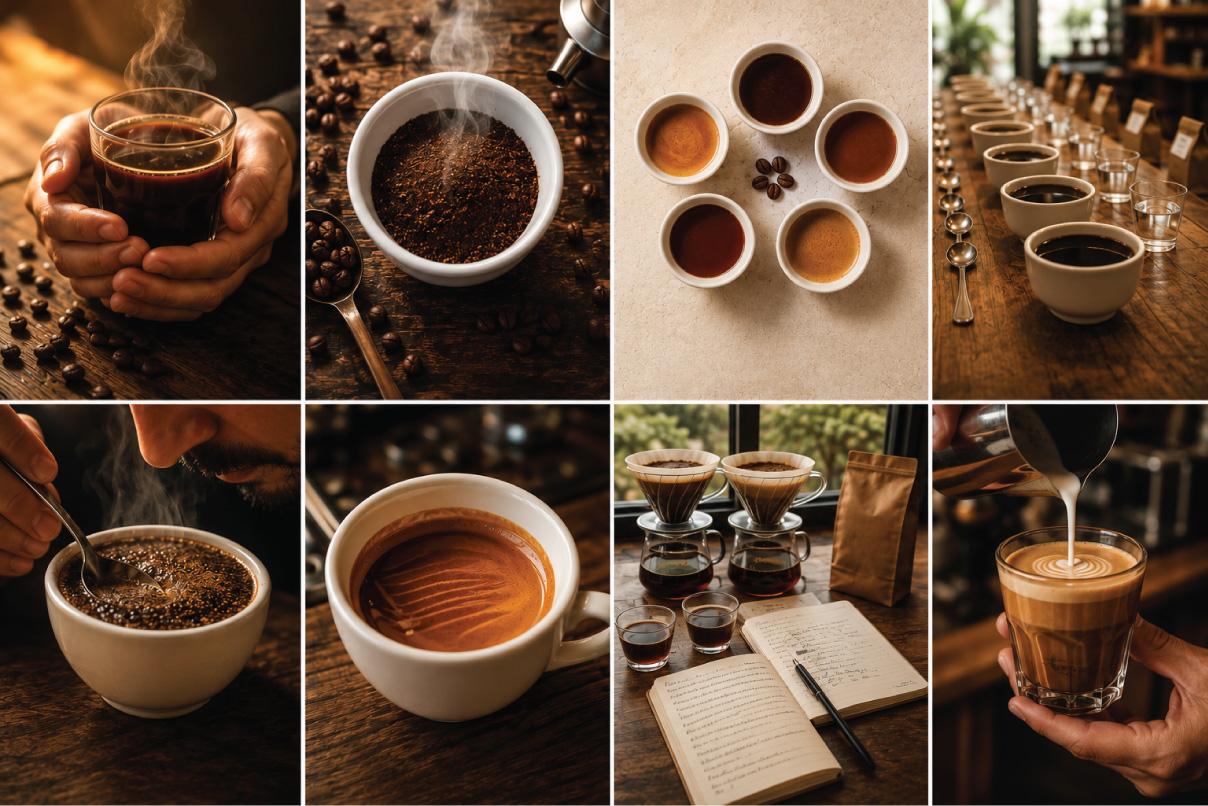
How to Taste Coffee Like a Professional Barista
The complete guide to evaluating coffee with your senses — from fragrance and acidity to body and aftertaste. Learn the same techniques used by Q Graders, competition baristas, and the team at Cortado Coffee House in Madaba.
In This Article
- Why Learning to Taste Matters
- Fragrance vs. Aroma — The First Evaluation
- The Five Pillars: Acidity, Sweetness, Bitterness, Body, Aftertaste
- Balance — Where Everything Converges
- The Coffee Flavour Wheel Explained
- Professional Cupping: The SCA Protocol
- The 100-Point Scoring System
- How to Taste Espresso
- How to Taste Filter Coffee
- Comparing Origins Through Tasting
- Practical Exercises to Train Your Palate
- Common Beginner Mistakes
- Tasting at Cortado Coffee House
- Frequently Asked Questions
Most people drink coffee. Very few people taste it. The difference is not pretension — it is attention. Drinking is automatic: the cup reaches your lips, the liquid goes down, and within seconds you have moved on to the next thought. Tasting is deliberate: you slow down, you engage your senses in sequence, and you pay attention to what the coffee is actually doing in your mouth. The first approach gives you caffeine. The second gives you an entirely new understanding of what coffee can be.
Professional baristas, Q Graders, and roasters have spent years training their palates to detect, identify, and articulate the hundreds of flavour compounds present in a single cup of coffee. The good news is that the fundamental skills they use are not mysteries reserved for industry professionals. They are learnable techniques built on a simple foundation: knowing what to pay attention to, and in what order. This article teaches you exactly that — the same sensory evaluation framework used by the Specialty Coffee Association, adapted for anyone who wants to get more from every cup they drink.
Section One
Why Learning to Taste Coffee Matters
Coffee is one of the most chemically complex beverages humans consume. A single cup of brewed coffee contains over 1,000 volatile aromatic compounds — more than wine, more than chocolate, more than virtually any other food or drink. Yet most people experience coffee as a single, undifferentiated sensation: "it tastes like coffee." Learning to taste properly does not change the coffee. It changes your ability to perceive what was always there.
The practical benefits are immediate. When you can identify acidity, you can tell the difference between a well-extracted shot and an under-extracted one. When you can evaluate body, you understand why a Colombian espresso feels different from an Ethiopian one. When you can recognise sweetness and distinguish it from added sugar, you begin to understand why freshness, roast level, and extraction parameters matter so much. Tasting is not an academic exercise — it is the skill that transforms coffee from a commodity into an experience.
1,000+
Volatile aromatic compounds in a single cup of brewed coffee
110
Distinct flavour attributes on the SCA Coffee Taster's Flavour Wheel
19
Sensory exams required to earn Q Grader certification
Section Two
Fragrance vs. Aroma — The First Evaluation
Professional tasting begins before the coffee touches your lips. It begins with your nose — and it distinguishes between two related but different olfactory experiences that most people collapse into one.
Fragrance is the smell of dry, freshly ground coffee before any water is added. When you open a bag of freshly ground beans and inhale, you are evaluating fragrance. In a professional cupping session, cuppers lean over cups of dry grounds and inhale deeply, noting the initial aromatic character. Fragrance gives you a preview: floral notes, fruit sweetness, chocolate depth, roast character, and freshness (or lack thereof) are all detectable at this stage. Stale coffee announces itself immediately in the fragrance — the volatiles that carry complexity degrade over time, leaving behind flat, papery, or woody notes.
Aroma is the smell of the coffee after water has been added. When hot water contacts the grounds, it triggers a cascade of chemical reactions that release a second wave of volatile compounds — many of which were locked inside the cell structure of the bean and become accessible only through the heat and moisture of brewing. The aroma of wet coffee is typically richer, more complex, and more representative of what the coffee will taste like than the dry fragrance alone.
| Attribute | Fragrance (Dry) | Aroma (Wet) |
|---|---|---|
| When Evaluated | After grinding, before water | After hot water is added |
| What It Reveals | Freshness, roast level, initial character | Flavour complexity, origin character, defects |
| Key Indicators | Floral, fruity, chocolate, stale/flat | Berry, citrus, caramel, spice, ferment |
| Intensity | Subtler — many compounds still locked in cells | Richer — heat releases volatile aromatics |
Barista Tip: Train your nose by smelling your coffee at three stages: immediately after grinding (fragrance), immediately after pouring water (wet aroma), and after breaking the crust at four minutes (the burst of aromatic release). You will notice different notes at each stage — and that awareness alone separates a casual drinker from a thoughtful taster.
Section Three
The Five Pillars — Acidity, Sweetness, Bitterness, Body, Aftertaste
Once the coffee enters your mouth, five primary attributes define the experience. Professional tasters evaluate each one separately before considering how they interact. Understanding these five pillars is the single most important step in learning to taste coffee like a professional.
1. Acidity — The Life of the Cup
Acidity is the most misunderstood word in coffee. It does not mean sour, and it has nothing to do with the pH level of the brew or with stomach discomfort. In specialty coffee, acidity refers to a bright, lively, pleasant sharpness — typically perceived toward the front of the mouth and the sides of the tongue. It is what gives coffee its vibrancy, its sparkle, its sense of life. A coffee with no acidity tastes flat and dull, like water with brown colouring. A coffee with well-developed acidity tastes alive.
Different organic acids contribute different qualities. Citric acid (found abundantly in high-altitude washed coffees from Ethiopia and Kenya) produces a lemon-like freshness. Malic acid creates a juicy, apple-like brightness. Phosphoric acid — rarer, found in some exceptional Kenyan lots — produces a sparkling, almost effervescent sensation. Tartaric acid contributes a grape-like tartness. Learning to recognise which type of acidity you are tasting is one of the more advanced skills, but simply recognising that acidity is present and pleasant is a significant first step.
Coffee Myth: "Acidity means the coffee is acidic and bad for your stomach." This is false. The acidity evaluated in tasting refers to a flavour sensation — brightness and liveliness — not to pH levels. Specialty coffee typically has a pH between 4.85 and 5.10, which is less acidic than orange juice, tomatoes, or wine.
2. Sweetness — The Foundation of Quality
Sweetness in coffee does not come from sugar — it comes from the natural sugars and carbohydrates present in the coffee bean, developed through careful cultivation at the right altitude, harvested at peak ripeness, and preserved through proper processing and roasting. Sweetness is perceived primarily at the tip of the tongue. In high-quality specialty coffee, sweetness forms the foundation of the entire flavour experience — it balances acidity, moderates bitterness, and provides the canvas on which other flavour notes appear.
When professionals say a coffee is "sweet," they mean it possesses a natural, inherent sweetness that does not require sugar or syrups to be pleasant. This is why freshness matters so much: the volatile compounds that create perceived sweetness degrade rapidly after roasting. Coffee consumed 7–21 days after roast is demonstrably sweeter than the same coffee at 60 days.
Did You Know? The Maillard reaction during roasting converts amino acids and reducing sugars in the green bean into hundreds of new flavour compounds — including the caramel, toffee, and honey notes that contribute to perceived sweetness. Under-roasted coffee tastes grassy because this reaction is incomplete. Over-roasted coffee tastes bitter because the sugars have carbonised.
3. Bitterness — The Necessary Counterweight
Bitterness is perceived primarily at the back of the tongue and the soft palate. In coffee, it is an inevitable and often desirable part of the flavour balance. The key distinction is between pleasant bitterness — the kind found in dark chocolate, tonic water, or a well-extracted espresso — and unpleasant bitterness caused by over-extraction, over-roasting, or stale beans.
A well-made espresso at proper parameters (93–94°C, 9 bars, 25–30 seconds) will have a subtle, controlled bitterness that provides depth and structure to the shot without overwhelming sweetness or acidity. If the bitterness dominates, something has gone wrong — the grind was too fine, the extraction ran too long, the water was too hot, or the beans were roasted too dark.
4. Body — How the Coffee Feels
Body is not a flavour — it is a physical sensation. It describes the weight, texture, and viscosity of the coffee as it sits on your tongue. Think of it as the difference between skimmed milk and whole cream: both are white liquids, but they feel completely different in your mouth. The same principle applies to coffee.
| Body Description | Feels Like | Typical Origins / Methods |
|---|---|---|
| Light / Tea-like | Delicate, clean, almost watery | Washed Ethiopian Yirgacheffe; light-roast filter |
| Medium / Rounded | Satisfying weight without heaviness | Washed Colombian; balanced espresso blends |
| Full / Syrupy | Thick, coating, viscous | Natural Ethiopian Guji; Sumatran; dark roasts |
| Creamy | Smooth, silky, buttery | Honey-processed lots; well-extracted espresso |
Body is influenced by several factors: the coffee's origin and variety, the processing method (natural processing adds body; washed processing reduces it), the roast level (darker roasts tend to feel heavier), the brewing method (espresso concentrates body; filter dilutes it), and even the water chemistry used for brewing.
5. Aftertaste — The Lasting Impression
Aftertaste (sometimes called "finish") is what remains in your mouth after you have swallowed or spat out the coffee. In high-quality coffee, the aftertaste is clean, pleasant, and lingering — it continues to develop and reveal new notes for 15–30 seconds after swallowing. In lower-quality or defective coffee, the aftertaste is abrupt, ashy, harsh, or unpleasantly dry (astringent).
Professionals pay close attention to aftertaste because it reveals the truth about extraction quality. An espresso that tastes pleasant on initial sip but leaves a harsh, metallic aftertaste was likely over-extracted. A coffee with a beautiful fragrance but a flat, disappearing finish may have been under-extracted or past its freshness peak.
Quick Tip: After swallowing, close your mouth and exhale slowly through your nose. This retronasal olfaction (smelling "backwards" through the nasal passages) picks up flavour compounds that your tongue alone cannot detect, and often reveals the most distinctive notes of a coffee — the jasmine in a Yirgacheffe, the blueberry in a Guji natural, the toffee in a Colombian Huila.
Section Four
Balance — Where Everything Converges
Balance is not a separate attribute — it is the relationship between all the attributes you have already evaluated. A balanced coffee is one where acidity, sweetness, bitterness, and body exist in harmonious proportion: no single element dominates or disappears. Acidity gives the cup life. Sweetness gives it foundation. Bitterness gives it depth. Body gives it presence. When all four are calibrated correctly — by nature, by the farmer's decisions, by the roaster's craft, by the barista's extraction — the result is a cup that feels complete.
Balance does not mean blandness. A bright, citric Ethiopian coffee can be perfectly balanced if its acidity is supported by adequate sweetness and a clean finish. A rich, chocolatey Colombian can be perfectly balanced if its sweetness is counterpointed by enough acidity to prevent heaviness. The question is not whether the coffee is intense or mild — it is whether every element earns its place.
"Balance is not the absence of extremes. It is the presence of everything in the right proportion. A balanced coffee makes you forget you are analysing — you are simply enjoying." — Cortado Coffee House, Madaba
Section Five
The Coffee Flavour Wheel — Your Sensory Map
The Coffee Taster's Flavour Wheel is the most widely used tool for identifying and communicating coffee flavours. Originally published in 1995 and substantially updated in 2016 by the Specialty Coffee Association in partnership with World Coffee Research, the current wheel contains 110 distinct flavour attributes organised in concentric rings that move from general categories at the centre to highly specific descriptors at the outer edge.
How to Use the Flavour Wheel
The wheel is designed to be read from the inside out. Start at the centre with the broadest sensory impression — does this coffee taste fruity? Nutty? Floral? Sweet? — then move outward through increasingly specific levels. If the coffee strikes you as "fruity," the next ring asks: is it berry-like, citrus-like, stone fruit, or dried fruit? If berry-like, the outermost ring asks: is it specifically blueberry, strawberry, or raspberry?
Floral
Jasmine, rose, chamomile, lavender. Common in washed Ethiopian and Kenyan coffees. Delicate and aromatic.
Fruity
Berry, citrus, stone fruit, tropical, dried fruit. Broad category spanning blueberry to mango to raisin.
Nutty / Cocoa
Chocolate, almond, hazelnut, peanut. Common in Colombian, Brazilian, and Central American coffees.
Sweet
Caramel, honey, maple, vanilla, brown sugar. The foundation of pleasant, well-developed roasts.
Spices
Cinnamon, clove, nutmeg, pepper, cardamom. Often present in Indonesian, Indian, and aged coffees.
Roasted
Tobacco, pipe smoke, dark chocolate, burnt sugar. Increases with roast level. Desirable in moderation.
The Flavour Wheel is not a test — it is a vocabulary. No one expects you to identify "blackberry with cinnamon undertones and a malt finish" in your morning coffee. But having the language available allows you to move from "this tastes good" to "this tastes like dark chocolate with a citrus finish" — which is a more useful, more communicable, and frankly more enjoyable way to experience coffee.
Did You Know? The 2016 Flavour Wheel was built from the World Coffee Research Sensory Lexicon — a scientific reference system where every attribute has a precise definition and a physical reference sample. The "blueberry" descriptor, for instance, is calibrated against a specific commercial blueberry product so that tasters worldwide can agree on what "blueberry" means in coffee.
Section Six
Professional Coffee Cupping — The SCA Protocol
Cupping is the standardised method professionals use to evaluate coffee. It strips away the variables of brewing method, equipment, and barista skill, leaving only the coffee itself to be judged. In November 2024, the Specialty Coffee Association adopted three new Coffee Value Assessment (CVA) standards — SCA-102, SCA-103, and SCA-104 — replacing the original 2004 protocol. The fundamental mechanics, however, remain consistent and remarkably simple.
01
Grind and Evaluate Fragrance
Weigh 8.25 grams of coffee per cup and grind coarsely (slightly finer than French press). Lean over the cup and inhale the dry fragrance of the grounds. Note your first impressions: fresh or stale? Floral or chocolatey? This dry evaluation sets expectations for what follows.
02
Add Water and Evaluate Aroma
Pour water at 93°C (200°F) directly over the grounds, filling the cup to approximately 150 ml. A crust of grounds will form on the surface. Do not disturb it yet. Lean over the cup and note the wet aroma rising from the crust — this second olfactory evaluation often reveals notes not present in the dry fragrance.
03
Break the Crust at Four Minutes
At exactly four minutes, use the back of a cupping spoon to push the crust gently back — three strokes from front to back. As you break the crust, bring your nose close to the surface and inhale. This is the most aromatic moment of the entire cupping process: the crust break releases a concentrated burst of volatile compounds. Note everything you detect.
04
Skim the Surface
Using two spoons, skim the remaining foam and floating grounds from the surface of the coffee. Do not stir or agitate the liquid — the settled grounds at the bottom should remain undisturbed. The coffee is now ready to taste.
05
Slurp and Evaluate
Take a spoonful of coffee and slurp it forcefully — the aeration spreads the liquid across your entire palate and vaporises volatile compounds into your nasal passages simultaneously. Evaluate flavour, acidity, body, sweetness, and aftertaste. Taste at three temperature points as the coffee cools: hot (immediately), warm (around 70°C), and cool (below 40°C). Many coffees reveal their true character — especially sweetness and fruit notes — only as they cool.
Barista Insight: The slurp is not optional or theatrical — it is functional. Slurping atomises the coffee, creating a fine mist that coats the palate and reaches the retronasal olfactory receptors simultaneously. A gentle sip delivers flavour to the tongue. A proper slurp delivers flavour to the tongue and the nose at once — which is how professionals detect the full range of a coffee's complexity.
Section Seven
The 100-Point Scoring System — How Professionals Grade Coffee
The specialty coffee industry uses a 100-point scale administered through the Coffee Quality Institute's Q Grader programme. Q Graders are certified sensory professionals who have passed 19 rigorous examinations covering cupping, triangulation (identifying the odd cup in sets of three), olfactory skills, organic acid identification, and green and roasted coffee grading. They are the sommeliers of the coffee world.
| Score Range | Grade | What It Means |
|---|---|---|
| 90–100 | Outstanding / Exceptional | Extraordinarily rare. Complex, distinctive, and memorable in every attribute. Competition-level lots. |
| 85–89.99 | Excellent / Single-Origin Quality | Distinctive origin character, notable complexity. Worthy of single-origin presentation. |
| 80–84.99 | Very Good / Specialty Grade | The baseline for "specialty" coffee. Clean, pleasant, with identifiable positive attributes. |
| Below 80 | Below Specialty / Commercial | May have defects or lack distinction. Not classified as specialty coffee. |
The score is derived from individual ratings across multiple attributes: fragrance/aroma, flavour, aftertaste, acidity, body, balance, uniformity, clean cup, sweetness, and overall impression. Each attribute is scored on a scale, and the total determines the final grade. A coffee scoring 80 points is genuinely good — it means every attribute meets a professional standard of quality. A coffee scoring 90 is genuinely rare — most professionals taste fewer than a dozen 90+ coffees in a year.
Section Eight
How to Taste Espresso — A Concentrated Challenge
Espresso amplifies everything. The pressure extraction concentrates flavour compounds into a 25–40 ml volume, which means every positive quality and every defect is magnified. Tasting espresso requires the same sensory framework as cupping, but applied in a compressed timeline — and with an additional visual dimension that cupping does not offer.
Step 1: Visual Evaluation — Read the Crema
Before tasting, look at the espresso. A well-extracted shot has a crema (the layer of emulsified oils and CO₂ on the surface) with a hazelnut to reddish-brown colour, a few millimetres thick, that springs back when you cut through it with a spoon. Light, thin, quickly dissipating crema suggests under-extraction. Very dark, nearly black crema suggests over-extraction. However — and this is important — crema is an indicator, not a guarantee. Some excellent coffees produce modest crema, and some mediocre coffees produce abundant crema. Taste always has the final word.
Step 2: Aromatic Evaluation — Smell Before You Sip
Bring the cup to your nose immediately after extraction. The aromatic window of espresso is shorter than cupping — the small volume cools quickly, and volatile compounds dissipate faster. Note the initial aroma: is it sweet and inviting, or harsh and smoky? Floral and fruity, or flat and roasty? First impressions from espresso aroma are remarkably reliable predictors of what the shot will taste like.
Step 3: Taste in Sequence
Take a small sip — not a slurp (espresso is too concentrated for cupping-style aeration). Let the liquid spread across your palate. Evaluate in this order:
- Initial impression — What hits you first? Sweetness? Acidity? Bitterness? The first sensation tells you about the extraction balance.
- Mid-palate development — As the espresso moves across your tongue, does the flavour develop and change? Great espresso evolves. Mediocre espresso stays flat.
- Body and texture — Is the mouthfeel syrupy, creamy, thin, or chalky? Does the shot feel like velvet or like water?
- Finish and aftertaste — Swallow and wait. Does the flavour linger pleasantly? Does it disappear? Does it leave bitterness, astringency, or sweetness?
Coffee Myth: "Good espresso must have thick crema." Not necessarily. Crema thickness depends on CO₂ content (which relates to roast freshness), bean variety, and machine pressure. Some of the best single-origin espressos — particularly lighter-roasted Ethiopian lots — produce thinner crema than dark Italian blends but taste vastly more complex. Judge crema as one data point, not the verdict.
Section Nine
How to Taste Filter Coffee — The Full Spectrum
If espresso is a concentrated magnification of certain qualities, filter coffee is a wide-angle lens that captures the full range. Brew methods like V60, Chemex, and Aeropress extract a broader spectrum of flavour compounds over a longer contact time and at a lower concentration than espresso. The result is a cup where delicate floral, fruity, and tea-like notes — often hidden or overpowered in espresso — can express themselves fully.
The tasting approach for filter coffee mirrors cupping more closely. Because the volume is larger and the temperature drops more slowly, you have more time to evaluate the coffee as it cools — and the evolution of flavour from hot to cool is one of the most revealing aspects of filter tasting. A coffee that tastes pleasantly acidic at 70°C may reveal deep fruit sweetness at 50°C and a clean, lingering honey finish at 40°C. This temperature journey is why specialty baristas often recommend drinking filter coffee slowly rather than rushing through it.
Home Tasting Exercise: Brew the same coffee two ways — as espresso and as filter (V60 or French press). Taste both side by side. Notice what espresso amplifies (body, bitterness, sweetness intensity) versus what filter reveals (acidity nuance, floral notes, delicate fruit). This single exercise will teach you more about the relationship between brew method and flavour than any amount of reading.
Section Ten
Comparing Origins Through Tasting
One of the most illuminating exercises in coffee education is tasting coffees from different origins side by side. When you drink a single coffee in isolation, its flavour profile is all you know. When you taste it next to a coffee from a different origin, the contrast sharpens your perception of both.
| Origin | Classic Flavour Profile | What You'll Learn |
|---|---|---|
| Colombia | Chocolate, caramel, nuts, medium acidity, balanced | What balance and approachability taste like |
| Ethiopia (Washed) | Jasmine, bergamot, citrus, tea-like body | What floral acidity and lightness feel like |
| Ethiopia (Natural) | Blueberry, strawberry, wine-like, full body | How processing transforms flavour |
| Brazil | Peanut, chocolate, low acidity, heavy body | What low acidity and heavy body feel like |
| Kenya | Blackcurrant, grapefruit, sparkling acidity | What intense, phosphoric acidity feels like |
Start with the contrast that teaches the most: Colombia vs. Ethiopia. These two origins represent the widest flavour gap in the specialty world — Colombian balance and chocolate sweetness against Ethiopian floral complexity and bright acidity. Tasting them side by side will calibrate your palate for every comparison that follows.
Section Eleven
Practical Exercises to Train Your Palate at Home
Professional tasters are not born with superhuman senses. They develop their skills through deliberate practice — and every exercise they use can be replicated at home with minimal equipment.
Exercise 1: Acid Calibration
Dissolve tiny amounts of citric acid (lemon juice), malic acid (green apple juice), and tartaric acid (grape juice) in water. Taste each. Now taste your coffee and try to identify which acid type is dominant. This trains you to distinguish between types of acidity.
Exercise 2: Body Spectrum
Taste skimmed milk, semi-skimmed, whole milk, and cream in sequence. Notice how the weight and viscosity increase. Now taste two coffees — one light-bodied (washed Ethiopian) and one full-bodied (natural Indonesian). Map them onto the milk spectrum.
Exercise 3: Sweetness Detection
Brew two cups of the same coffee: one with fresh beans (7–14 days post-roast) and one with beans over 60 days old. Taste both side by side. The difference in sweetness will be unmistakable — and it will permanently change how you think about freshness.
Exercise 4: Aroma Training
Smell common flavour references with your eyes closed: cinnamon stick, dark chocolate, lemon zest, blueberry jam, jasmine tea. Build your aromatic memory. Then, when you smell coffee, ask: which of these references does it remind me of?
Exercise 5: Triangulation
Brew three cups: two from the same coffee, one from a different origin. Without knowing which is which, taste all three and identify the odd one out. This is the same test Q Graders must pass — and it sharpens your ability to detect subtle differences.
Exercise 6: Temperature Tasting
Brew one cup and taste it at five-minute intervals as it cools from 70°C to room temperature. Write down what you taste at each stage. You will discover that coffee reveals entirely different flavour notes at different temperatures.
Section Twelve
Common Beginner Mistakes — And How to Avoid Them
- Confusing acidity with sourness — Acidity is bright, clean, and pleasant. Sourness is sharp, harsh, and unpleasant. Sourness in espresso usually means under-extraction (too coarse a grind, too short a time). If your coffee tastes sour, the problem is extraction — not the bean.
- Tasting immediately after brewing — Scalding-hot coffee overwhelms your taste buds and hides flavour nuance. Let espresso cool for 30–60 seconds and filter coffee for 2–3 minutes before your first evaluative sip. Many of the best flavours appear only as the temperature drops.
- Searching for one "correct" flavour — Tasting notes on a bag are a suggestion, not a prescription. If the bag says "blueberry and jasmine" but you taste "dark grape and honey," your perception is not wrong — it is yours. Flavour perception is influenced by genetics, diet, and experience.
- Only tasting one coffee — Flavour perception is comparative. Tasting a single coffee in isolation is like listening to a single instrument and trying to evaluate the orchestra. Always taste at least two coffees side by side — the contrast sharpens your perception of both.
- Judging espresso entirely by crema — Thick crema looks impressive but does not guarantee quality. Some of the most complex single-origin espressos produce modest crema. Taste the shot. If the crema is beautiful but the taste is bitter and flat, the beauty is meaningless.
- Skipping the smell — Approximately 80 per cent of what we perceive as "taste" is actually processed through olfactory receptors in the nose. If you skip the fragrance and aroma evaluation, you are missing the majority of the information available to you.
Section Thirteen
How Cortado Coffee House Approaches Tasting
At Cortado Coffee House on Al-Yarmouk Street in Madaba, tasting is not a private ritual reserved for staff training sessions. It is a daily practice that shapes every cup we serve — and a skill we actively share with any guest who wants to learn.
Every morning before the doors open, our baristas perform a calibration tasting. They pull espresso shots from the current bean lot, evaluate acidity, sweetness, body, and aftertaste, and adjust grind size and dose until the extraction meets our standard. This is not optional. Bean density shifts with humidity. Grind requirements change as beans age. The espresso that was perfect yesterday may need a two-second timing adjustment today. Daily tasting is how we detect that shift and correct for it before the first guest orders.
When we introduce a new single-origin lot — whether a Colombian Huila with deep chocolate sweetness or an Ethiopian Yirgacheffe with jasmine and lemon brightness — we taste it multiple ways: as espresso, as a cortado (where the 1:1 milk ratio reveals how the coffee interacts with dairy), and as filter. Each method highlights different aspects of the coffee's character, and the results of that tasting determine how we present the coffee on our menu and what we recommend to guests who ask.
"Tasting is not a performance. It is a responsibility. Every cup that leaves our bar has been preceded by a tasting that morning — a calibration that ensures the espresso in your cortado is the best version of itself we can produce today." — Cortado Coffee House barista training standards
If you visit Cortado Coffee House and want to develop your own tasting skills, ask. Our baristas can walk you through a guided tasting of our current offerings — explaining the origin, the processing method, the roast profile, and what to pay attention to as you drink. You will not become a Q Grader in a single visit. But you will leave understanding your coffee in a way you did not before — and every cup you drink after that will be richer for the experience.
Frequently Asked Questions
Coffee Tasting — Your Questions Answered
What is the difference between coffee tasting and coffee cupping?
Coffee cupping is a specific standardised protocol used by professionals to evaluate coffee quality — with defined ratios, temperatures, and procedures set by the Specialty Coffee Association. Coffee tasting is the broader skill of evaluating any coffee, brewed by any method, using sensory analysis. Cupping is one form of tasting, but tasting skills apply to every cup you drink.
How long does it take to develop good tasting skills?
Most people notice significant improvement within 2–4 weeks of deliberate practice — tasting two or more coffees side by side each day and paying conscious attention to acidity, sweetness, body, and aftertaste. Becoming a certified Q Grader typically requires months of preparation and years of professional experience.
What does acidity mean in coffee tasting?
Acidity in coffee tasting refers to a bright, lively, pleasant sharpness — not stomach acidity or pH level. It is perceived toward the front of the mouth and is considered a positive quality in specialty coffee. High-quality acidity makes the coffee taste alive, vibrant, and interesting.
Why do professionals slurp coffee when tasting?
Slurping atomises the coffee into a fine mist that coats the entire palate and simultaneously vaporises aromatic compounds into the nasal passages. This allows the taster to perceive both taste (via the tongue) and aroma (via retronasal olfaction) at the same time, revealing the full complexity of the coffee.
What is a Q Grader?
A Q Grader is a certified coffee sensory professional, trained and examined by the Coffee Quality Institute. Certification requires passing 19 separate sensory exams covering cupping, olfactory skills, acid identification, triangulation, and coffee grading. Q Graders are the coffee industry's equivalent of wine sommeliers.
What score makes coffee "specialty grade"?
A coffee must score 80 or above on the 100-point SCA scale to be classified as specialty grade. Scores of 85 and above are considered excellent single-origin quality. Scores of 90 and above are exceptionally rare and represent the highest tier of coffee quality.
Can I learn coffee tasting without professional training?
Absolutely. The fundamental skills — evaluating fragrance, acidity, sweetness, body, and aftertaste — can be practiced at home with any brewed coffee. Tasting two coffees side by side, paying deliberate attention, and building your vocabulary with the Coffee Flavour Wheel are all accessible without formal certification.
Does thick crema mean good espresso?
Not necessarily. Crema thickness depends on CO₂ content, bean variety, and machine pressure — not solely on quality. Some excellent single-origin espressos produce thin crema, while some mediocre dark roasts produce thick crema. Crema is one visual indicator, but taste is always the definitive measure of espresso quality.
Can I do a coffee tasting at Cortado Coffee House in Madaba?
Yes. Cortado Coffee House offers guided tastings of current single-origin offerings. Our baristas can walk you through the sensory attributes of each coffee, explain the origin and processing, and help you identify what you taste. Visit us on Al-Yarmouk Street, Madaba — open daily 8:00 AM to 10:00 PM.
Free on iOS & Android
Discover What's Pouring Today
Browse the full Cortado Coffee House menu, check our current single-origin offerings, and order ahead so your coffee is ready when you arrive.
Ready to Taste the Difference?
The best way to learn coffee tasting is to taste great coffee — prepared with precision, served with care, and explained by people who understand it. That is what we do every day at Cortado Coffee House in Madaba.
Leave a comment
Your email address will not be published. Required fields are marked *
Where Passion Meets Craft
Cortado Coffee House was built on one belief — that great coffee deserves great care. With 18 years of specialty coffee experience behind every cup, we bring expertise, warmth, and an uncompromising commitment to quality to every visit.
Contact Info
- Al-Yarmouk St., Madaba
- +962779210093
- info@cortado-coffee.com