- Al-Yarmouk St., Madaba - Next to Mosaic City Hotel
- Daily : 8.00 am to 10.00 pm
Where Passion Meets Craft
Cortado Coffee House was built on one belief — that great coffee deserves great care. With 18 years of specialty coffee experience behind every cup, we bring expertise, warmth, and an uncompromising commitment to quality to every visit.
Contact Info
- Al-Yarmouk St., Madaba
- +962779210093
- info@cortado-coffee.com
- 27 June, 2026
- By: Mohammad Ali
Your complete guide to specialty coffee in Madaba — from bean origins and roasting to the café experience at Cortado Coffee House.
Coffee Culture · Madaba
Quality Coffee in Madaba From the Bean to the Cup, Nothing Less
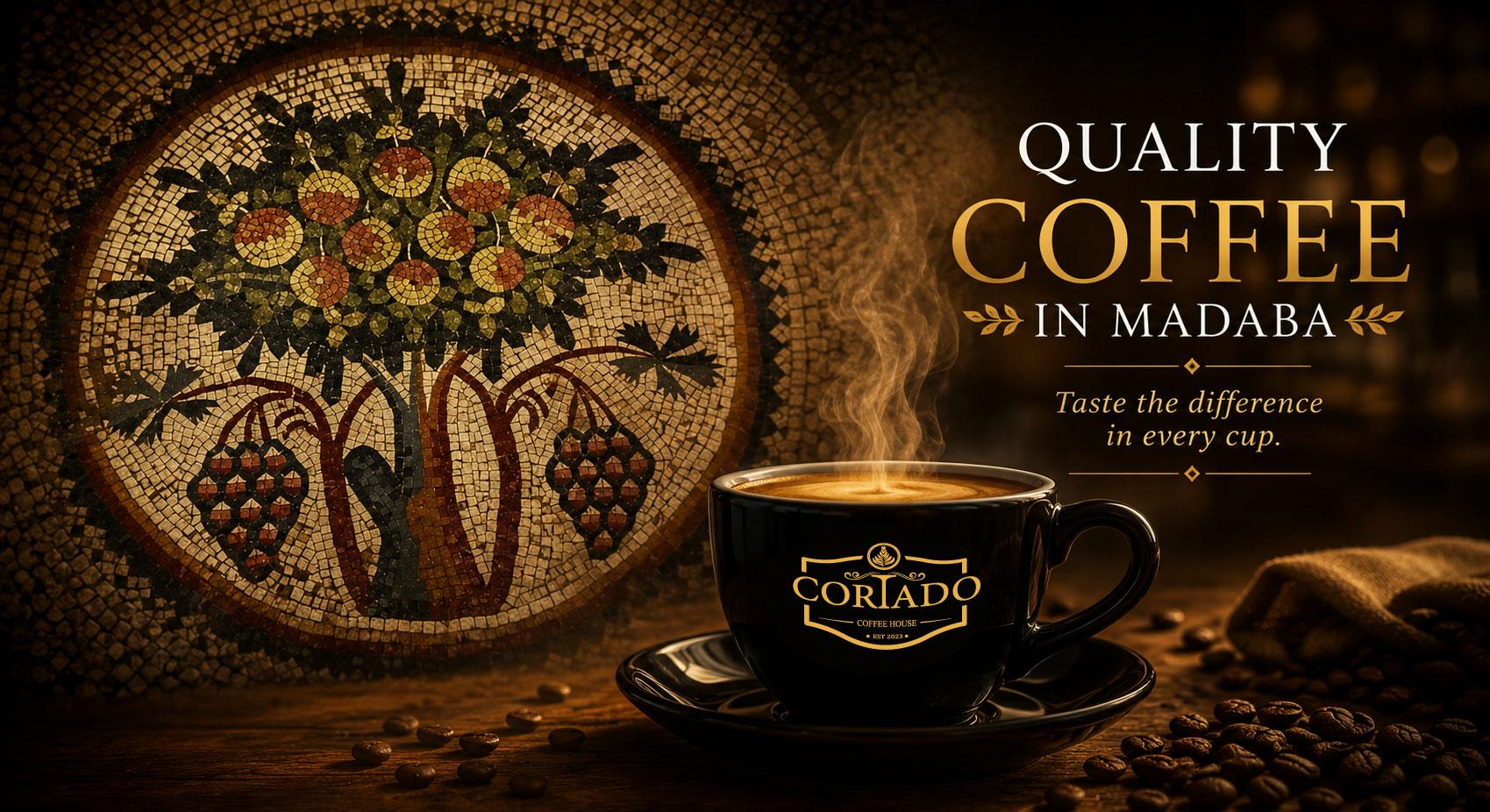
There is a quiet revolution brewing in the heart of Madaba — one that smells of freshly ground Ethiopian Yirgacheffe, sounds like the hiss of a precision espresso machine, and tastes like everything a great cup of coffee should be.
In This Article
- Why Quality Coffee Matters in Madaba
- What Is Specialty Coffee — Really?
- The Bean: Where Quality Begins
- The Roast: Unlocking the Flavour
- The Brew: Craft in Every Cup
- Latte Art and the Barista's Signature
- The Full Cortado Menu Experience
- Ambiance: The Fourth Ingredient
- Loyalty, Community and Coffee Culture
- Finding Cortado Coffee House in Madaba
Section One
Why Quality Coffee Matters in Madaba
Madaba is a city of depth. Known internationally as the City of Mosaics, its streets carry centuries of craft, colour, and intention. The same instinct that guided Byzantine artisans to place each tiny stone tile precisely — building an image one deliberate choice at a time — is the same instinct that defines what quality coffee should be. Not a commodity poured quickly and forgotten, but an experience assembled with care, knowledge, and pride.
For years, coffee in Jordan's cities was divided between two extremes: the centuries-old tradition of cardamom-spiced Arabic qahwa on one end, and mass-produced international chains on the other. What was missing in Madaba — what residents quietly wanted — was a third path. A café that understood specialty coffee as both a science and an art, that sourced beans with the same seriousness a chef brings to ingredients, and that created a space warm enough to linger in, yet refined enough to feel like something special.
That is precisely why Cortado Coffee House was founded here in 2023. Not to compete with tradition, but to add a new dimension to it. To say: Madaba deserves the world's best coffee. And the world's best coffee deserves Madaba.
Did you know? The word "cortado" comes from the Spanish verb cortar — to cut. A cortado is espresso "cut" with a small amount of warm milk to reduce acidity while preserving intensity. It is, in many ways, the perfect metaphor for what we do: balance, precision, and the courage to keep things essential.
Quality coffee matters in Madaba because the people of Madaba matter. Families who gather on weekend mornings deserve a cup that makes the moment feel worthy of the occasion. University students who need a focused afternoon deserve something honest and energising, not something burned and bitter. Tourists arriving to see the famous mosaic map of the Holy Land deserve to leave with a second memory — the memory of an extraordinary cup of coffee, enjoyed in a place they will want to return to.
Quality coffee matters because coffee — done right — is not a transaction. It is a relationship between the farmer who grew the cherry, the roaster who unlocked its potential, the barista who extracted it with precision, and the guest who receives it. Every link in that chain matters. And when every link is strong, something extraordinary happens in the cup.
Section Two
What Is Specialty Coffee — Really?
The term "specialty coffee" is used widely — sometimes casually, sometimes misleadingly. So what does it actually mean? The Specialty Coffee Association (SCA) defines specialty coffee as coffee that scores 80 points or above on a 100-point grading scale, evaluated by a certified Q Grader across criteria including aroma, flavour, aftertaste, acidity, body, balance, uniformity, clean cup, sweetness, and overall impression.
In practice, this means specialty coffee is the top 3–5% of all coffee grown in the world. It comes from specific farms, at specific altitudes, harvested during specific seasons, processed with specific methods. It is the opposite of commodity coffee — the kind that blends origins together, prioritises volume over character, and is designed to taste the same everywhere, always.
80+ SCA Score Required Every bean we serve meets the Specialty Coffee Association's minimum score threshold.
3–5% Of World Production Specialty coffee represents only a tiny fraction of all coffee produced globally each year.
200+ Flavour Compounds A well-grown, well-roasted specialty coffee can contain over 200 distinct aroma and flavour compounds.
1,000m+ Altitude Grown Most specialty beans are grown above 1,000 metres, where cooler temperatures slow development and intensify flavour.
At Cortado Coffee House, we do not use the word "specialty" lightly. Every origin we serve has been selected based on its cup score, its traceability to a specific farm or cooperative, and the story it tells. We believe our guests deserve to know where their coffee comes from — which valley, which farmer's hands, which harvest season. That transparency is a core part of what we mean when we say quality coffee in Madaba.
Specialty coffee is not an upgrade from regular coffee. It is a fundamentally different product — one grown, processed, roasted, and brewed with a level of intention that transforms a daily habit into a genuine sensory experience.
— The Cortado Coffee House Philosophy
Section Three
The Bean: Where Quality Begins
Coffee begins long before it reaches a café. It begins in the soil. The altitude. The rainfall. The variety of the plant. The method by which the coffee cherry is processed after harvesting. These factors — collectively called terroir, a concept borrowed from winemaking — shape everything that follows.
Origin Matters
At Cortado, we source beans from several of the world's most celebrated coffee-growing regions. Ethiopia — the ancestral home of the Arabica coffee plant — produces beans with extraordinary floral and berry notes, particularly from the Yirgacheffe and Sidama regions. Colombia offers a classic balance of brightness and sweetness, with red fruit and caramel notes that feel universally approachable. Guatemala brings a darker, more chocolatey profile, with mild spice and rich body that makes it ideal for espresso-based drinks.
Seasonal rotation is part of our sourcing philosophy. Because specialty coffee is a harvest product — tied to seasons and years — we change our single-origin offerings as the best lots become available. This means that a return visit to Cortado may introduce you to a Kenyan AA from a cooperative in Nyeri, or a washed Guatemalan from a small family farm in Huehuetenango. No two seasons are identical. That is something we celebrate rather than standardise away.
Arabica vs. Robusta
All of our espresso and filter offerings are 100% Arabica — the species known for its complexity, acidity, and aromatic richness. Robusta, while having its place in certain traditional blends, is higher in caffeine and chlorogenic acids, which often produces a harsh, rubbery bitterness that we do not consider consistent with a specialty experience. For guests who specifically enjoy a strong, dense espresso body, our house blend achieves that through roast and extraction technique rather than species compromise.
Processing: The Hidden Variable
How a coffee cherry is processed after picking profoundly shapes the cup. The three primary methods are washed (wet), natural (dry), and honey. Washed coffees — where the fruit is removed before drying — produce clean, bright, highly transparent flavour profiles where the bean's intrinsic character shines. Natural coffees — dried with the fruit intact — develop fruity, wine-like, sometimes fermented notes of remarkable complexity. Honey-processed coffees fall between: some mucilage is left on the bean, adding body and sweetness while retaining some clarity.
We offer all three processing styles across our menu, depending on the season and origin. Our baristas are trained to explain these differences and help guests choose based on their flavour preferences — whether they lean toward the clean precision of a washed Ethiopian or the lush sweetness of a natural Brazilian
Section Four
The Roast: Unlocking the Flavour
A green coffee bean is, on its own, nearly flavourless — a dense, grassy seed. The Maillard reaction, caramelisation, and hundreds of chemical transformations that occur during roasting are what unlock the thousands of volatile aromatic compounds that define a coffee's character. Roasting is where science and intuition meet — and where a bean's potential is either realised or lost.
Coffee roasts are commonly described on a spectrum from light to medium to dark. Each position on that spectrum tells a different story. Light roasts preserve the most origin-specific character — the terroir, the variety, the processing method. They tend to be higher in acidity and brightness, with more nuanced flavour complexity. Medium roasts bring a balance between origin character and roast-developed sweetness and body. Dark roasts push the roast character to the foreground, developing bittersweet chocolate and smoky notes, but at the cost of the bean's more delicate qualities.
At Cortado, we work exclusively with roasters who share our commitment to transparency and traceability. We favour light-to-medium roasts for our filter and single-origin offerings, allowing guests to experience the coffee's origin character. For our espresso blend, we use a carefully developed medium roast that balances sweetness, body, and crema production — ideal for milk-based drinks like lattes and flat whites without losing its core flavour identity.
Freshness is non-negotiable. We serve coffee within 7–21 days of its roast date — the window during which CO₂ off-gassing has stabilised but the volatile aromatics are still vibrant and alive. Older coffee goes stale. Fresh coffee blooms.
Section Five
The Brew: Craft in Every Cup
Great beans and a great roast are necessary conditions for quality coffee in Madaba — but they are not sufficient ones. The final variable is extraction: how water interacts with ground coffee to dissolve and suspend its soluble compounds. Extraction is where the barista's skill becomes the decisive factor.
Espresso
Our espresso is pulled on a calibrated professional machine at 93–94°C water temperature, 9 bars of pressure, with a 25–30 second extraction time, targeting a 1:2 brew ratio (one part ground coffee producing two parts liquid espresso). Every variable — grind size, dose, distribution, tamping pressure — is dialled in daily and adjusted for humidity and atmospheric conditions. The result is a concentrated, balanced shot with natural sweetness, body, and a persistent crema.
Filter Coffee
For guests who want to explore origin character more openly, we offer pourover filter coffee using the V60 and Chemex methods. Filter brewing uses a coarser grind, lower water temperature (90–93°C), and a longer extraction time to produce a cleaner, more delicate cup that highlights the brightness and aromatics of single-origin beans. Our baristas brew each filter cup to order — not in bulk — ensuring the freshest, most precise result every time.
Cold Brew
Our cold brew is steeped for 18 hours in filtered water at a controlled low temperature. This long, cold extraction produces a naturally sweet, low-acid concentrate that is smooth and easy to drink — particularly popular in Madaba's warm months. Unlike iced coffee (which is simply hot-brewed coffee poured over ice), cold brew is a fundamentally different product: richer, rounder, and with a different flavour chemistry altogether.
- 01 Grind Fresh, Every Time We grind coffee to order using calibrated burr grinders. Pre-ground coffee begins losing volatile aromatics within minutes. The difference in freshness is immediately perceptible in the cup.
- 02 Filtered Water at the Right Temperature Water makes up 98% of a brewed cup. We use filtered water with controlled mineral content — enough TDS (Total Dissolved Solids) to extract fully, not so much that it introduces unwanted flavours.
- 03 Calibrated Ratios Every brew method has an optimal coffee-to-water ratio. We follow SCA extraction guidelines and adjust daily based on feedback and tasting.
- 04 Tasting is Part of the Process Our baristas taste their espresso every morning during dial-in. A cup that is not good enough for us is not good enough for our guests — full stop.
Section Six
Latte Art and the Barista's Signature
Latte art is often perceived as decoration — a pretty pattern on top of a drink. But in a specialty coffee context, it is something more significant than that. The ability to pour a consistent, well-defined rosette, tulip, or heart in steamed milk requires the milk to be textured to a precise microfoam consistency: silky, glossy, with bubbles small enough to be invisible to the naked eye, at a temperature of exactly 60–65°C.
This means that latte art is a quality indicator. If a barista can consistently produce clean, defined patterns, it demonstrates that their milk steaming technique is correct — which in turn means the texture of the drink is correct, the temperature is within the ideal range, and the espresso underneath has enough crema and body to support the pour. A beautiful latte in Madaba is not just a photograph — it is evidence of craft.
When a barista pours a perfect rosette, they are not showing off. They are proving that every step before that moment was done right — the grind, the pull, the steam, the temperature. The art is the proof.
— Cortado Barista Training Philosophy
Our baristas undergo continuous latte art training, not because we want Instagram photos (though we welcome them), but because we want our guests to receive a cup that is correct in every technical dimension. A cortado with a perfect heart pour. A flat white with a defined tulip. A latte with a full rosette that holds its shape until the last sip. These are not accidents. They are the result of training, repetition, and genuine care.
Section Eight
Ambiance: The Fourth Ingredient
If we were to list the ingredients of a perfect cup of coffee at Cortado, they would be: the bean, the roast, the brew technique — and the space in which it is enjoyed. Ambiance is not an afterthought in our philosophy. It is the fourth ingredient, as carefully considered as the grind size or the water temperature.
The physical environment of Cortado Coffee House was designed to honour two things simultaneously: the warmth of Madaba's generous hospitality culture, and the precision of the specialty coffee world. The colour palette references the warmth of coffee itself — deep browns, warm cream tones, accents of gold that evoke both the crema of a perfect espresso and the mosaic tiles that have defined Madaba's artistic identity for centuries.
Lighting is low and warm — intentionally so. We believe that good coffee deserves an environment that invites people to slow down, to be present, to taste rather than gulp. Natural light filters through large windows in the morning hours, creating the specific quality of sunlight that makes a first coffee of the day feel like a ritual rather than a routine.
The sound environment at Cortado is equally considered. Music is present but never dominant — a curated background of jazz, ambient, and neo-soul that complements conversation without competing with it. The sounds of the café itself — the low hum of the espresso machine, the rhythmic knock of the portafilter, the soft hiss of milk steaming — are part of the atmosphere, a kind of sensory reassurance that craft is in progress.
Cortado is designed to be your space. Whether you arrive for a focused solo working session, a quiet catch-up with a friend, a family weekend morning, or simply fifteen minutes of uninterrupted peace with a good cup — the space adapts to you. No time limits. No pressure. Just excellent coffee and the freedom to be.
Section Nine
Loyalty, Community and Coffee Culture
Quality coffee in Madaba is not just about what is in the cup. It is about what gathers around it. Coffee has always been a social act — a reason to sit together, to talk, to share time. In Jordan, this tradition is ancient. Coffee is offered as an act of welcome, hospitality, and respect. We carry that spirit forward at Cortado, extending it into a contemporary specialty café context.
Our loyalty rewards programme, available through the Cortado app, allows regular guests to earn points with every order. But beyond the practical benefit, it is our way of recognising the people who make Cortado what it is. Our regulars are not just customers — they are part of the community that gives this café its identity, its energy, its reason for being here.
We host regular events — cupping sessions where guests can taste multiple coffees side by side and learn to identify flavour differences; brewing workshops where anyone can learn to make a great V60 at home; and occasional talks about coffee origin, sustainability, and the global coffee supply chain. We believe an educated coffee drinker is a happier coffee drinker. And that when people understand what they are drinking, they appreciate it more deeply.
We are also deeply committed to the idea that specialty coffee should be accessible, not elitist. We price our menu to reflect the quality of what we serve while remaining welcoming to everyone. Specialty coffee is sometimes associated with a certain exclusivity — a language of origins and processing methods that can feel intimidating. Our baristas are trained to be educators, not gatekeepers. Ask any question. No question is too basic. If you have never had a cortado before, we will be honoured to introduce you to one.
Coffee is not just a drink. It is a reason to gather. A language of hospitality spoken across cultures, generations, and geographies. In Madaba, we are proud to speak that language fluently.
— Cortado Coffee House, Madaba 2023
Section Ten
Finding Cortado Coffee House in Madaba
Cortado Coffee House is located in the heart of Madaba — close enough to the city's famous Byzantine mosaic sites to make it a natural stop on any cultural visit, and embedded enough in the daily life of the neighbourhood to feel like it has always been here.
We are open seven days a week, from early morning through the evening hours, because we believe quality coffee should be available whenever someone needs it — whether that is a 7am espresso before the day begins, a mid-afternoon pourover to power through a project, or a late-evening decaf cortado that ends the day on a perfect note.
If you are visiting Madaba for the first time — perhaps to see the mosaic map of the Holy Land at Saint George's Church, or to explore the archaeological museum, or simply to experience one of Jordan's most historically rich cities — we invite you to add Cortado to your itinerary. Not as an obligation, but as a reward. Walk the ancient streets. See the extraordinary mosaics. Then find us, sit down, and let us make you something truly worth remembering.
If you are a resident of Madaba, we simply want to say: welcome home. This café exists because of you, for you, and in honour of this city that deserves nothing less than the best. Come as you are. Bring someone you love. Stay as long as you like. The coffee is always worth it.
You can follow us on Instagram and Facebook for daily updates, seasonal menu announcements, event schedules, and — inevitably — a great deal of latte art. Download our app to join the loyalty programme and ensure that every visit to Cortado builds toward something special.
Quality coffee in Madaba is no longer a search. It is an address. And that address is Cortado Coffee House.
Leave a comment
Your email address will not be published. Required fields are marked *
Where Passion Meets Craft
Cortado Coffee House was built on one belief — that great coffee deserves great care. With 18 years of specialty coffee experience behind every cup, we bring expertise, warmth, and an uncompromising commitment to quality to every visit.
Contact Info
- Al-Yarmouk St., Madaba
- +962779210093
- info@cortado-coffee.com