
- Al-Yarmouk St., Madaba - Next to Mosaic City Hotel
- Daily : 8.00 am to 10.00 pm
Where Passion Meets Craft
Cortado Coffee House was built on one belief — that great coffee deserves great care. With 18 years of specialty coffee experience behind every cup, we bring expertise, warmth, and an uncompromising commitment to quality to every visit.
Contact Info
- Al-Yarmouk St., Madaba
- +962779210093
- info@cortado-coffee.com
- 28 June, 2026
- By: Mohammad Ali
Discover why Madaba, Jordan is one of the Middle East's most rewarding destinations — the world's oldest mosaic map, Mount Nebo, Dead Sea, Ma'in Hot Springs, and the best specialty coffee in the city at Cortado Coffee House.
🗺️ Travel Guide · Madaba, Jordan · 2025
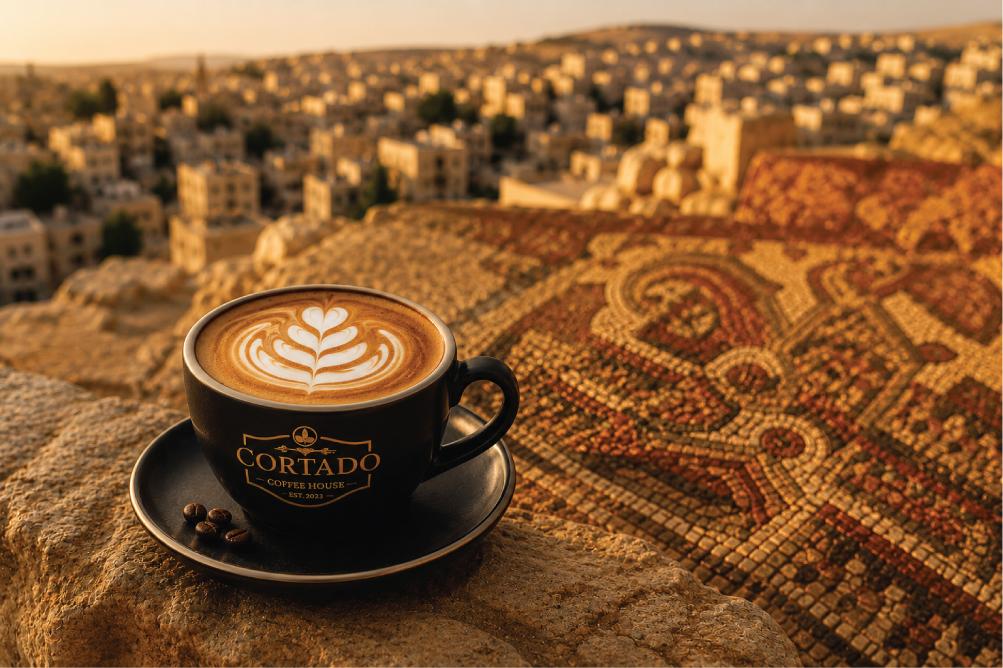
10 Reasons to Visit Madaba, Jordan — And Why Coffee Should Be on Your Itinerary
The oldest map in the world. A biblical mountain overlooking the Promised Land. A city where Byzantine mosaics meet Jordanian hospitality — and where one specialty coffee house has become a destination in its own right.
4,500
Years of documented history in Madaba
AD 560
Date of the world's oldest surviving map of the Holy Land
30 km
Distance from Amman — and 30 min from Queen Alia Airport
760 m
Elevation above sea level — pleasant climate year-round
📋 The 10 Reasons
- The World's Oldest Map — St. George's Church
- Mount Nebo — Where Moses Saw the Promised Land
- The Dead Sea — 30 Minutes Away
- Ma'in Hot Springs — A Hidden Natural Oasis
- Byzantine Mosaics — An Entire City as Art
- Jordanian Cuisine — The Taste of the Levant
- Location — The Perfect Jordan Base Camp
- Religious Heritage — Where Three Faiths Meet
- Wadi Mujib & Nature — Jordan's Grand Canyon
- Specialty Coffee — Cortado Coffee House
There are cities that travellers pass through on their way to somewhere else. And then there are cities that, once visited, make you rethink everything you thought you knew about a country. Madaba, Jordan is firmly the second kind.
Most visitors encounter Madaba as a quick stop on the road from Amman to the Dead Sea or Petra — time enough to glance at the famous mosaic map and move on. But that approach misses almost everything. Madaba is a city of extraordinary depth: archaeological layers that stretch back 4,500 years, mosaics that rival anything in Rome or Ravenna, proximity to some of the most significant biblical sites on earth, a food culture rooted in centuries of Levantine tradition, and — increasingly — a specialty coffee scene that has put the city on a different kind of map.
This is the complete guide to why Madaba deserves more than a quick stop. Ten reasons, fully researched, honestly written, and ending where every great day in Madaba should end: with a perfect cup of coffee.
01
The World's Oldest Map of the Holy Land — St. George's Church
The single most important reason to visit Madaba — and one of the most remarkable objects on earth
In 1884, Christian builders arriving in Madaba from the city of Karak — where tensions had forced the Christian community to relocate — began constructing new homes on the ruins of an ancient Byzantine settlement. Beneath the rubble of one structure, they uncovered a mosaic floor unlike anything they had seen. Among its thousands of coloured tiles was a detailed geographical representation of the Holy Land and surrounding regions — complete with cities, rivers, mountains, roads, and landmarks labelled in Greek.
This was the Madaba Mosaic Map, crafted around AD 560 during the Byzantine period. Now housed in the floor of the Greek Orthodox Church of Saint George — built in 1896 directly over the discovery site — it remains to this day the oldest surviving map of Palestine and the Holy Land in existence, and one of the most extraordinary archaeological finds of the 19th century.
"Crafted in AD 560, the map has 157 captions in Greek depicting all the major biblical sites of the Middle East, from Egypt to Palestine. It was originally around 15 to 25 metres long and 6 metres wide, and once contained more than two million pieces." — Lonely Planet: St. George's Church & Mosaic Map, Madaba
The surviving portion — approximately one quarter of the original — still contains between 700,000 and 800,000 pieces of naturally coloured stone tesserae. You can identify the Jordan River, the Dead Sea (complete with fish swimming away from its hypersaline waters), the walled city of Jerusalem with the Church of the Holy Sepulchre clearly visible, Jericho and its palm trees, Bethlehem, the Nile Delta, and dozens of villages and settlements across the region as they existed 15 centuries ago.
Date CreatedAround AD 542–570, Byzantine period
Original SizeOver 2 million pieces; 15–25m × 6m
Entry Fee1 JD per person (approx. $1.40 USD)
Opening HoursSat–Thu 8am–5/6pm, Fri 9:30am–5pm
Visitor Tip: Spend time in the interpretative centre at the ticket office before entering the church — the displays provide essential context that will help you identify specific landmarks in the mosaic. The map's orientation faces east (not north as on modern maps), so allow a few minutes to reorient your mental compass. On Fridays and Sundays, the church opens at 7am for Mass — visitors are welcome to attend but may not view the map during services.
02
Mount Nebo — Where Moses Saw the Promised Land
10 km from Madaba · One of the most biblically significant sites on earth
Just 10 kilometres northwest of Madaba — a 15-minute drive or an easy taxi ride — stands one of the most spiritually charged locations in the world. Mount Nebo, approximately 817 metres above sea level, is the site identified in the Book of Deuteronomy as the place where Moses climbed to see the Promised Land before his death.
"And Moses went up from the plains of Moab to Mount Nebo, the top of Pisgah, which is opposite Jericho, and the Lord showed him all the land." (Deuteronomy 34:1). According to scripture, Moses died on this mountain and was buried here — never having crossed into the land he had spent 40 years leading his people toward. The site has been a Christian pilgrimage destination since at least the 4th century AD, when monks constructed a small church on the summit to honour Moses.
"From its summit, one sees panoramic views over the Jordan Valley, the Dead Sea, and in clear weather, even Jericho and Jerusalem. Those views remain one of the most powerful draws for pilgrims and tourists alike." — Timeless Travel: Mount Nebo, Jordan
Today the Memorial Church of Moses stands on the highest peak, known as Siyagha, managed by the Franciscan Custody of the Holy Land following a major renovation completed in 2016. Inside, remarkable 6th and 7th century Byzantine mosaics survive in excellent condition, depicting hunting scenes, pastoral landscapes, winemaking, and geometric patterns using the same tesserae techniques visible at Madaba's churches below. Outside the church stands the Brazen Serpent Monument — a striking bronze sculpture by Italian artist Giovanni Fantoni that fuses the biblical bronze serpent of Numbers 21 with the Christian cross.
Pope John Paul II visited Mount Nebo on March 20, 2000, during his millennium pilgrimage to the Holy Land, planting an olive tree beside the chapel as a symbol of peace. Pope Benedict XVI also visited in 2009. The site draws pilgrims from Judaism, Christianity, and Islam — all three Abrahamic faiths hold Moses in reverence.
Distance10 km from Madaba; 15-min drive
Entry Fee2–3 JD (not covered by Jordan Pass)
HoursSummer 8am–6pm; Winter 8am–4pm
Visit Duration45–90 minutes recommended
Visitor Tip: Visibility from the summit is best in the morning hours of spring (March–May) and autumn (September–November). Summer heat haze can reduce visibility significantly at midday. On the clearest days, you may see the outline of Jerusalem approximately 50 km to the west across the Jordan Valley — the same view Moses is said to have beheld.
The Mosaic Connection
Mount Nebo's Byzantine mosaics and the Madaba Mosaic Map are part of the same 6th-century artistic tradition — made by the same communities, using the same techniques, in the same generation. After visiting both, a stop at Cortado Coffee House in Madaba gives you time to sit with what you've seen. History benefits from a good cup of coffee and unhurried reflection.
03
The Dead Sea — The Lowest Point on Earth, 30 Minutes Away
A natural wonder unlike anything else — and one of Jordan's most iconic experiences
Located approximately 30 kilometres from Madaba — a scenic 45-minute drive down through the Jordan Valley — the Dead Sea is one of earth's most extraordinary geographical phenomena. Sitting at approximately 430 metres below sea level, it is the lowest point on the surface of the planet. Its water is so dense with minerals and salt (roughly 10 times saltier than the ocean) that human bodies float effortlessly on the surface — swimming is impossible, but floating requires no effort at all. The experience of lying back on the water, held up entirely by its density, with the hills of the West Bank visible across the shimmering surface, is genuinely unlike anything else in the world.
The Dead Sea's mineral-rich mud has been used for therapeutic and cosmetic purposes for millennia — Cleopatra reportedly had minerals imported from its shores for her beauty treatments. Today, the tradition continues in the form of the "mud mask ritual" that every visitor performs: coating yourself in the black mineral mud found on the shoreline, letting it dry, then washing it off in the buoyant water. The minerals — magnesium, calcium, potassium, bromine — are said to benefit skin conditions, joint pain, and circulation.
Distance from Madaba~30 km; 45-minute drive
Elevation~430 m below sea level — lowest on Earth
AccessResort day passes or public beach available
Best ForFloating, mud masks, mineral spa treatments
Visitor Tip: Avoid shaving or waxing 24 hours before entering the Dead Sea — the salt concentration makes any small cut or abrasion intensely uncomfortable. Bring water shoes as the rocky shoreline can be sharp. The drive from Madaba to the Dead Sea is itself spectacular, descending through the Jordan Valley with increasingly dramatic desert scenery and Dead Sea Panorama viewpoints along the way.
04
Ma'in Hot Springs — A Thermal Oasis in the Desert
37 km from Madaba · One of Jordan's best-kept secrets
Dramatically situated in the hills between Madaba and the Dead Sea, the Ma'in Hot Springs (Hammamat Ma'in) are a geothermal wonder that surprises every visitor who encounters them. Cascading waterfalls of naturally heated mineral water pour down the cliffs of the Zarqa Ma'in valley into pools below — a lush, tropical-feeling oasis that appears with startling suddenness in the middle of the Jordanian desert landscape. The water temperatures range from pleasantly warm to genuinely hot (some springs exceed 60°C), and the mineral composition is rich in sulphur, calcium, and magnesium.
The springs form the centrepiece of the Ma'in Hot Springs Resort, located approximately 37 kilometres from Madaba. Day visitors can access the public pools for approximately 15 JD per person, or pay around 38 JD for full spa facility access. The setting — waterfalls, thermal pools, volcanic rock formations, and the distant shimmer of the Dead Sea below — makes Ma'in one of the most scenically dramatic relaxation experiences in the entire Middle East.
Visitor Tip: The Ma'in valley is best visited in the morning when temperatures are cooler and the light is most photogenic. Combine a morning at the Dead Sea with an afternoon at Ma'in (or vice versa) for a full day of natural wonder with Madaba as your base. The route between the two passes through magnificent desert canyon scenery.
After the Springs — Before You Leave Madaba
After a morning at Ma'in's thermal pools, the drive back to Madaba takes under an hour. There is no better way to close a day of natural wonder than settling into Cortado Coffee House on Al-Yarmouk Street with a perfectly pulled cortado and time to do absolutely nothing except enjoy it.
05
Byzantine Mosaics — An Entire City as a Living Gallery
Madaba's mosaics go far beyond St. George's — they are everywhere
The Madaba Mosaic Map is the city's most celebrated artwork, but it is far from the only one. Madaba earned its name "the City of Mosaics" honestly — hundreds of mosaic floors from the 5th through 7th centuries are scattered throughout its churches, public buildings, and private homes, many of them still in situ beneath modern structures or carefully preserved in museums and archaeological sites.
The Major Mosaic Sites Beyond St. George's
Madaba Archaeological Park & Museum — Built adjacent to the Madaba Visitors Centre, the park contains the remains of a Roman road flanked by columns, the Church of the Virgin Mary (featuring a beautifully preserved mosaic floor dating to 767 AD), the crypt of Saint Elianos, the Hippolytus Hall (with a famous mosaic depicting the myth of Hippolytus), and the Church of Prophet Elias. Many argue that the finest mosaics in Madaba are here, not at St. George's. Entry: 2 JD, or included with the Jordan Pass.
The Church of the Apostles — Houses the largest single mosaic floor in Madaba, dedicated to the twelve apostles and featuring a stunning central medallion of a female figure representing the Sea, surrounded by fish, birds, plants, and animals. The craftsmanship rivals anything in the Byzantine world.
The Madaba Mosaic Institute — A working restoration school where skilled artisans — many of them from multigenerational Madaba families — continue the ancient craft of mosaic-making using traditional techniques. Visitors can watch the restoration of ancient pieces and purchase contemporary mosaic art created by local craftspeople.
Visitor Tip: Allow at least a full day — preferably two — to do justice to Madaba's mosaic heritage. The sites are walkable from a central location, and the Madaba Visitors Centre can provide maps and context for each site. Spring and autumn are ideal visiting seasons, with temperatures between 20–30°C and manageable crowds.
06
Jordanian Cuisine — The Taste of the Levant at Its Best
Madaba's food culture is as rich as its history — and far less crowded than Amman
Jordan's cuisine is one of the great underrated food cultures of the Middle East — a blend of Bedouin, Levantine, and Mediterranean influences that has developed over centuries of crossroads geography. And Madaba, with its relaxed pace and authentic local restaurant scene, is one of the best places in the country to experience it without tourist markup or city crowds.
Dishes You Must Try in Madaba
Mansaf — Jordan's national dish and a genuine cultural institution. Tender slow-cooked lamb served over white rice and shrak bread (a paper-thin flatbread), the whole assembly soaked in jameed — a tangy, intensely flavoured sauce made from dried fermented goat yoghurt. Mansaf is traditionally eaten standing, with the right hand, in a communal setting that embodies the Jordanian spirit of generosity and shared table. Madaba's local restaurants serve it authentically and affordably.
Mezze — The Levantine tradition of multiple small sharing dishes that precede the main meal. Expect hummus (made fresh, not from a jar), baba ghanoush (smoky roasted aubergine), waraq enab (vine leaves stuffed with herbed rice), fattoush (crisp bread salad with sumac and pomegranate), moutabal, and a dozen other small dishes that together constitute a complete and extraordinarily flavourful meal.
Musakhan — Roasted chicken marinated with sumac, caramelised onions, and rich olive oil, served over taboun bread. One of the region's most balanced and satisfying dishes — the sumac's tartness, the sweetness of the onions, and the depth of good olive oil in perfect harmony.
Kunafa — The queen of Levantine desserts. Shredded pastry (kataifi) filled with sweet white cheese or cream, soaked in rose-water syrup, and scattered with crushed pistachios. In Madaba, it's made fresh and served warm. It is not optional.
After Dinner — The Perfect Conclusion
A full Jordanian dinner deserves a considered finale. The Italian tradition of ending a meal with a shot of espresso is not accidental — the concentration of flavour and the slight bitterness of a well-pulled shot cuts through richness, cleanses the palate, and closes the meal with intention. At Cortado Coffee House in Madaba, we make that espresso — and the cortado, latte, or flat white that follows it — with the same care you experienced at dinner.
07
Location — The Perfect Base Camp for Exploring Jordan
30 km from Amman · 30 min from the airport · Day-trip distance to Jordan's greatest sites
Madaba's greatest practical advantage is its geography. Sitting just 30 kilometres southwest of Amman on a highland plateau at 760 metres above sea level, it offers the accessibility of the capital without the noise, traffic, and expense. And from Madaba, virtually all of Jordan's major attractions are within striking distance of a day trip.
Queen Alia Airport30 minutes by car — ideal first and last night destination
Amman30 km, 40 minutes — easy day trip to the capital
Dead Sea~30 km, 45 minutes — the world's lowest point
Mount Nebo10 km, 15 minutes — biblical hilltop viewpoint
Ma'in Hot Springs37 km, 42 minutes — geothermal waterfall resort
Mukawir Castle45 km — Herodian fortress, John the Baptist site
Umm ar-Rasas30 km SE — UNESCO heritage, Roman-Byzantine ruins
Bethany Beyond the Jordan50 km — UNESCO baptism site of Jesus
Madaba's compact, walkable old city means you can explore its main sites on foot in a single day — but staying two or three nights transforms the experience. You get to leave early for Mount Nebo and be back for lunch. You can do the Dead Sea in the morning and Ma'in Hot Springs in the afternoon. You can explore the Archaeological Park at a genuinely leisurely pace rather than rushing. And every morning and evening, you have Cortado Coffee House nearby to begin and end the day properly.
Practical Note: The best time to visit Madaba is spring (March–May) and autumn (September–November), when daytime temperatures range between 20–30°C and the skies are often clear enough for the best visibility from Mount Nebo. Summer can exceed 35°C but remains manageable. Winter brings cooler temperatures (dipping below 10°C at night) and fewer crowds — a quieter but atmospheric time to visit.
08
Religious Heritage — Where Three Faiths Share a City
A genuinely rare example of multi-faith coexistence — and deeply moving to witness
Madaba is a majority-Muslim city with a historically significant Christian minority — and what makes it remarkable is how naturally and genuinely both communities have coexisted here for centuries. Christian churches of multiple denominations (Greek Orthodox, Roman Catholic, Anglican, Coptic) stand within walking distance of mosques, and the religious calendar of both communities is part of the fabric of daily life in the city.
The city contains a site remarkable even within this remarkable context: a mosque known locally as "The Mosque of Jesus Christ" — named to send an explicit message of coexistence and tolerance between the faiths that share Madaba as their home. For many visitors, this single detail encapsulates something essential about the spirit of Jordan as a whole: a country that has absorbed multiple civilisations, religions, and cultural traditions over four millennia and emerged from them not divided but layered, complex, and generous.
The nearby sites of Bethany Beyond the Jordan (40 minutes from Madaba, UNESCO World Heritage Site — the site of Jesus's baptism by John the Baptist) and Mount Nebo (revered by all three Abrahamic faiths as the mountain of Moses) make Madaba an extraordinary destination for religious pilgrims and secular history lovers alike.
Visitor Tip: If you are visiting Madaba on a religious pilgrimage or with an interest in interfaith history, consider combining the city's church visits with a trip to Bethany Beyond the Jordan (where guided tours are mandatory) and Mukawir Castle — the hilltop Herodian fortress traditionally identified as the site of John the Baptist's imprisonment and death.
09
Wadi Mujib — Jordan's Grand Canyon, on Your Doorstep
One of the most dramatic natural experiences in the Middle East
Jordan's natural landscape is as dramatic as its archaeology, and Wadi Mujib — a 212-square-kilometre nature reserve extending from the highlands above Madaba down through a spectacular gorge to the Dead Sea — is among its most extraordinary natural features. Known as "Jordan's Grand Canyon," the wadi is carved by seasonal rivers through sheer canyon walls of sandstone and basalt, creating a series of gorges, pools, waterfalls, and trails of breathtaking beauty.
The most accessible trail is the self-guided Siq Trail — a two-kilometre route through water-filled canyon passages, over ropes and rocks, past fast-flowing streams. It requires no technical skill but delivers the kind of physical adventure and dramatic scenery that most visitors do not expect to find so close to a quiet historic city. The trail is open April to October and costs approximately 21 JD, including a life jacket. Those seeking more technical challenges can attempt longer guided routes through the reserve.
Visitor Tip: Wadi Mujib is accessible from the Dead Sea Highway — you can combine it with a Dead Sea visit in the same day by planning your route appropriately. Wear shoes you don't mind getting wet. The Siq Trail ends at the Dead Sea shore, so the logistics work naturally. Book entry in advance during peak season (April–May and October), as the trail has daily visitor limits.
After the Canyon — You Deserve a Real Coffee
After wading through the Siq Trail, you will need: dry clothes, a good meal, and a coffee that matches the scale of what you've just experienced. Cortado Coffee House in Madaba is 45 minutes from the Wadi Mujib entrance. A cortado after a canyon is one of the better combinations we know of.
10
Specialty Coffee at Cortado Coffee House — Madaba's Best Cup
Al-Yarmouk Street · Next to Mosaic City Hotel · Open daily 8 AM – 10 PM
We have put coffee last on this list not because it is least important, but because every great itinerary deserves a conclusion. And in Madaba, the conclusion we recommend is a cup of coffee at Cortado Coffee House — the city's dedicated specialty coffee destination, and the place that has quietly made coffee a reason in itself to visit or return to Madaba.
Cortado Coffee House opened in 2023 on Al-Yarmouk Street in Madaba — directly next to Mosaic City Hotel — bringing 18 years of specialty coffee expertise to a city that has always understood the value of craft. The café takes its name from the cortado, a Spanish espresso drink made with equal parts espresso and steamed milk — a choice of name that is both a statement of identity and a standard of precision. Named after a drink that tolerates no shortcuts, Cortado Coffee House is built on Italian specialty espresso principles: traceable-origin beans, daily grinder calibration, 93°C extraction temperature, and a barista team trained to the level where every cup that leaves the bar is worth the wait.
"The cortado tolerates no shortcuts. Which is exactly why it is the drink we chose to put our name on. If we can make a perfect cortado every time, we can make any coffee drink perfectly." — Cortado Coffee House, Madaba · Est. 2023
Why Coffee Belongs on a Madaba Itinerary
This might seem like an unusual inclusion in a travel guide — but consider the context. Madaba is a city built on craft. The Byzantine mosaic makers who created the map in St. George's Church worked piece by piece, tile by tile, with the knowledge that the integrity of every small decision determined the quality of the whole. The same principle governs specialty coffee: the freshness of the bean, the precision of the grind, the temperature of the water, the timing of the extraction, the texture of the steamed milk — every element matters, and the result of getting each one right is something genuinely beautiful.
Visiting Madaba and not experiencing its coffee culture is like visiting a city famous for its architecture and spending the whole time staring at the pavement. Cortado Coffee House is not a consolation prize for when the museums close. It is a destination in its own right — a place where the city's spirit of craft and hospitality is expressed in liquid form, served in a glass, available every morning from 8am.
LocationAl-Yarmouk Street, Madaba — next to Mosaic City Hotel
HoursDaily 8:00 AM – 10:00 PM, all week
Signature DrinkThe Cortado — espresso & milk, 1:1, in a clear 4 oz glass
AppOrder ahead on iOS & Android — earn loyalty points
What to Order
If it is your first visit, order the Cortado — 4 oz, double espresso, equal-part steamed milk in a clear glass. It is the drink that gives the café its name and its standard. If you prefer something larger, the Flat White offers the same espresso intensity in a slightly more generous serve. For mornings, the Latte is the ideal companion to whatever the day ahead holds. Cold brew and iced options are available for Jordan's warmer months, and a rotating single-origin filter menu explores coffee origins from Ethiopia to Colombia — many of them connected to the same Arabica heritage that has been part of Jordan's cultural history for centuries.
Traveller Tip: Download the Cortado app before your visit — it allows you to order ahead so your coffee is ready when you arrive, earn loyalty points toward free drinks, and stay informed about new menu additions and seasonal offerings. Available free on the App Store and Google Play.
📱 Free on iOS & Android
Order Your Coffee Before You Arrive
Download the Cortado Coffee House app — browse the full menu, place your order in advance, earn loyalty points, and make every Madaba morning start exactly right.
Advance ordering Loyalty rewards on every purchase Full menu & seasonal specials Free drinks & exclusive offers
Frequently Asked Questions
Planning Your Visit to Madaba — Questions Answered
How many days should I spend in Madaba?
Two to three days is ideal to see the city's main attractions at a relaxed pace and take day trips to Mount Nebo, the Dead Sea, and Ma'in Hot Springs. One full day is enough for the core city sites (St. George's Church, the Archaeological Park, the Apostles' Church) if you are passing through on a Jordan itinerary.
What is the best time of year to visit Madaba?
Spring (March–May) and autumn (September–November) offer the most pleasant conditions, with daytime temperatures of 20–30°C and clear skies that maximise visibility from Mount Nebo. Summer can reach 35°C but remains manageable. Winter (December–February) is cooler and quieter, with temperatures sometimes below 10°C at night.
How do I get to Madaba from Amman?
Madaba is 30 km southwest of Amman — approximately 40 minutes by car. Taxis and private transfers are readily available from Amman and from Queen Alia International Airport (30 minutes). Shared minibuses (service taxis) also run between Amman's South Bus Station (Mujamma Raghadan) and Madaba for approximately 1 JD per person.
Is Madaba safe for tourists?
Jordan is consistently rated one of the safest countries in the Middle East for travellers. Madaba is a welcoming, family-oriented city where tourists are treated with warmth and genuine hospitality. Exercise the same common sense you would in any unfamiliar city — be respectful of local customs, dress modestly when visiting religious sites, and you will find Madaba an extremely comfortable destination.
Where is Cortado Coffee House in Madaba?
Cortado Coffee House is on Al-Yarmouk Street, Madaba — directly next to Mosaic City Hotel. Open daily from 8:00 AM to 10:00 PM. Contact via WhatsApp at +962 77 921 0093 or visit cortado-coffee.com.
Does the Jordan Pass cover Madaba's attractions?
The Jordan Pass covers entry to the Madaba Archaeological Park & Museum (included), but not St. George's Church (1 JD), and not Mount Nebo (2–3 JD). The Jordan Pass does cover Petra, Jerash, and many other major Jordanian sites, and is worth purchasing for any multi-day itinerary in Jordan.
Madaba Is Waiting. So Is Your Coffee.
Wherever your Jordan itinerary takes you — Petra, Wadi Rum, Jerash, Aqaba — Madaba is worth more than a stop on the way. It is a destination. Start and end each day here with a cup that matches the quality of everything around it.
Leave a comment
Your email address will not be published. Required fields are marked *
Where Passion Meets Craft
Cortado Coffee House was built on one belief — that great coffee deserves great care. With 18 years of specialty coffee experience behind every cup, we bring expertise, warmth, and an uncompromising commitment to quality to every visit.
Contact Info
- Al-Yarmouk St., Madaba
- +962779210093
- info@cortado-coffee.com